Issue and cover
artists: 1 Keith Parkinson (2000), 4 Charles Keegan (2002), 10
Denis Rodier (2007), 12 Bruce Pennington (2008), 15 Donato Giancola
(2011)
Learn the lore and allure of Black Gate!
Building on our June 2026 coverage of The
Legend of Top-Shelf Books Open Mic, the near-mythical, yet true, confluence
of many Black Gate contributors and authors, this Dark Muse News
post corners Chief Editor John O'Neill to detail the history of the magazine.
It's over 25 years old!
I learned about Black Gate magazine in 2010 at
the World Fantasy Convention, when Howard Andrew Jones espoused about it on a
panel. I immediately ordered Issue #15, and then the print run ended! Eh gad. I
was late for the party again! (Context in The
Legend of Top-Shelf Books post).
What I adore about Black Gate is its community
of contributors and readers. It attracts people ("Blackgaters") who
love fantasy literature and helping others enjoy it. If you are like me, you
did not join back in 2000, and the magazine, in all its forms, deserves some
explanation.
A condensed history of Black Gate magazine.
2000:
Publisher and Editor John O'Neill launched Black Gate's website in August,
ahead of the print release at the World Fantasy Convention in Corpus
Christi in October.
2008: Howard
Andrew Jones spearheaded the Black Gate: Adventures in Fantasy
Literature blog to create a premier destination for heroic fantasy
on the internet.
2011:
The 15th and final print issue was released, and the blog transformed to
post free, original pieces of short fiction every Sunday alongside
non-fiction essays.
2016: Black
Gate crossed 2 million page views per month and won both an Alfie
Award from George R.R. Martin and a prestigious World Fantasy Award.
2026:
You are here!
Learn the secrets of the grimoire that you are reading
now.
Become part of the lore. Record your Black Gate
memories in the comments!
John O'Neill in
Ottawa in 2022
Thanks for answering our questions, John. Why the name
“Black Gate”?
I love this question, because it delves right into the
nitty-gritty of BG’s history.
Black Gate came out of the dot.com boom of the
mid-nineties. I’d invested in a company called Cyberus – a play on Cerberus,
the 3-headed dog that guarded the gate to the underworld – that grew to become
the largest ISP in Ottawa, Canada. During the heady days of the 90s, we dreamed
of leveraging that success into other ventures, like an online gaming company.
My friend Wayne MacLaurin, CEO of Cyberus, registered blackgate.com as a
possible subsidiary of Cyberus, keeping that underworld motif alive.
Fast-forward a few years, and I’m researching prospective
names for my new fantasy magazine. Every URL I came up with had been nabbed by
that point. But I was surprised that one of my favorites was held by none other
than Wayne MacLaurin. With one quick email, Wayne and I partnered to launch
blackgate.com. Once we had the name, the magazine’s identity came together
quickly.
What were your motivations? The initial editorials (BG
#1 and #2) show a passion for keeping the fantasy magazine form alive.
I thought of Black Gate primarily as an online
business in those days. By the late 90s, I’d been deeply involved in a number
of internet startups, and had helped Dell Magazines and others launch the first
websites for Asimov’s SF, Analog, The Magazine of Fantasy & Science
Fiction, and many others. Demand for online content was exploding.
In 1995 I created an online science fiction hub called SF
Site, using Cyberus equipment and expertise. It grew to over a hundred
thousand monthly readers with virtually zero marketing, and we hosted F&SF
and other magazines for decades. Based on that success, I thought there was a
golden opportunity to launch a print magazine with a cutting-edge digital
presence.
In those days, magazines didn’t even sell subscriptions
online. I was convinced we could quickly establish a sizable online presence,
and show the world how to use the internet to rapidly grow a reader base and
launch a digital brand. I didn’t want us to repeat ourselves with another SF
property, so we chose fantasy.
I picked a genre that the market was clearly clamoring for –
adventure fantasy – and leveraged much of the talent we’d already attracted
with SF Site. We launched the website on August 30, 2000, and our first
issue went to press a few weeks later, just in time for the World Fantasy
Convention in October.
Somehow you got a crew of a dozen people to launch the
magazine. How did you enlist them?
That was easy. At that point SF Site had over 30
regular reviewers and staff, and I invited the most talented among that crew to
contribute – including Rich Horton, Victoria Strauss, Don Bassingthwaite, Marc
Goldstein, David Soyka, Charlene L. Brusso, Lisa DuMond, Paul J. McAuley, and
Todd Ruthman.
The big difference, of course, was that SF Site was a
fan site, whereas Black Gate was a professional publication – meaning we
paid for content. It was not a hardship to get most of the team to join.
Print Issues/Cover
Artist: 1 Keith Parkinson, 2 Hung Ving Mac, 3 Hung Vinh Mac, 4
Charles Keegan, 5 Chris Pepper, 6 Todd Lockwood, 7
Terri Lindsey, 8 Kenn Brown, 9 Dan Krall, 10 Denis
Rodier, 11 Alessanda Kelley, 12 Bruce Pennington, 13 Malcolm
McClinton, 14 Bruce Pennington, 15 Donato Giancola.
Black Gate 1 - November 2000, the print magazine
was born, but the first edition is a different size than the rest. I recall you
had a story about that. What was it?
Glad you asked about that. By 1998 I was part of the
Business Operations team for Motorola, in Schaumburg, Illinois, doing software
acquisitions. In one of the great bits of serendipity of my life, the corporate
lawyer I worked with on those deals was a guy named David Kenzer. I worked with
him every day for two years before discovering that he was the same David
Kenzer who owned one of my favorite game companies, Kenzer & Company,
publishers of Knights of the Dinner Table.
When Dave learned I wanted to publish a magazine, he brought
me to Skokie to introduce me to his printer, A to Z Printing. I knew that I
wanted a magazine that had the same sense of fun and adventure as the pulp
magazines I loved, and for that first meeting I brought a copy of Astounding
Science Fiction from the 1930s with me, to show the printer the size and
feel I was aiming for.
We settled on the oversize format we used for the first
issue, partly because it was the same size as the RPG supplements the printer
was used to. But we quickly discovered that a small reduction would allow us to
use smaller paper, at significant savings. Later issues were all published at
the smaller size.
Alfie Award for Integrity and Boneheadedness - Honored by
George RR Martin
This excerpt from John O'Neill comes from an Aug
2016 post. Watch the award acceptance speech on Youtube
Yesterday, while I was walking through the crowded halls of
Worldcon in the Kansas City Convention Center, I was given an invitation to the
Hugo Losers party, courtesy of the party’s distinguished host, George RR
Martin. I was quite flattered, as Black Gate was not
even up for a Hugo (we declined the
nomination, as we did last year, to make room for another nominee on the
ballot), but didn’t think much more about it.
The Hugo Losers party is the hottest ticket of the
convention, as I soon discovered. George personally hands out the Alfie Awards
to those Hugo losers whom he feels (quite rightly, I think) were unjustly
robbed of an award by slate shenanigans. And this year he spared no expense to
do it in style, renting out the Midland Theater, hiring a band, and plying
hundreds of guests with fabulous food and drink. The Awards themselves are
gorgeous, constructed of vintage hood ornaments, in honor of the design inspiration
for the first Hugo Awards.
George funds and hosts the awards, but the Alfie’s are in
truth a fan award… the winners are determined by the results of the Hugo
voting. But after the first few were awarded, George announced that the Alfie
committee had the right to give out special awards. And as the sole member of
the committee, he’d decided to give a special award this year to recognize one
publication “for integrity” in declining a Hugo nomination two years in a
row. Without further ado, George announced the award was to be given to Black
Gate, and I was called to the stage to accept it.
It was a very real honor for me. In a very real way George
exemplifies all that’s best about fandom — its inclusiveness, its quest to
reward excellence, and especially its talent for building a community. I was
very proud to accept the award on behalf of everyone who’s worked so hard to
make Black Gate a success these last few years.
Photo Credits -
Patty Templeton
Black Gate wins World Fantasy Award
Oct. 2016, John O'Neill posted
about winning the award; excerpt below.
Wow.
In 1996, I started SF Site, one of the first
genre websites. It quickly grew to over 150,000 readers per month. By 1998, as
the most innovative and forward-thinking publications in the genre were
creating the first ground-breaking websites, we decided to do something REALLY
forward-thinking: Launch a print magazine.
Black Gate lasted for 15 print issues, until
2011. In November 2008 our Managing Editor, Howard Andrew Jones, said we should
revamp the magazine’s website. I was the voice of reason. “Seriously, who wants
to read more than one article a month, Jones?”
Undaunted, Howard put together a top-notch team of writers,
and committed to putting daily content on the Black Gate blog.
It was his vision, and speaking personally, I still think it’s completely
bonkers.
But thanks to Bill Ward, David Soyka, Scott Oden, James
Enge, EE Knight, Judith Berman, Rich Horton, and especially Ryan Harvey for
getting the site off the ground (I still think it’s a crazy idea).
In 2010, C.S.E. Cooney commented that my articles would be
taken more seriously if the majority of the words were spelled correctly. She
became our first website editor, and she did an extraordinary job. She raised
our standards enormously.
Today Black Gate has 58 regular and
semi-regular bloggers — including many of you in the audience. Our mandate is
to cover the best neglected fantasy, past and present.
We’ve received many honors over the last decade, but nothing
like this. This is the highlight of 20 years of love and celebration of
fantasy, and on behalf of the entire Black Gate community, thank
you from the bottom of my heart.
John O'Neill and
Howard Andrew Jones at the World Science Fiction Convention, Washington DC,
December 19, 2021
Howard Andrew Jones championed expanding the Black
Gate website, transforming it into a mega-blog as it complemented the print
issue.
In January 2025, after Howard Andrew Jones lost his life to
brain cancer, John O'Neill remembered
his dear friend; the excerpt below captures Howard's heroism.
Howard has been a huge part of my personal and professional
life since 2002, when I opened a submission to Black Gate magazine
and found a long, rambling, and extremely enthusiastic cover letter from him,
expressing his delight at finding a quality magazine devoted to heroic fantasy.
The letter ended with “I want in, bad,” and was attached to a terrific tale
featuring two adventurers named Dabir and Asim…
In November 2008 Howard told me he wanted to remake our
website, and post new articles every single day, instead of a few times a
month. I told him he was crazy. How in the world could we produce that much
content, especially without a budget?
Undaunted, Howard put together a top-notch team of writers,
and committed to putting daily content on the Black Gate blog. It
was his vision, and he executed it magnificently, with a little help from Bill
Ward, David Soyka, Scott Oden, James Enge, EE Knight, Ryan Harvey, and others.
Eight years later, the website won a World Fantasy Award — an honor that I
still believe should have been presented to Howard.
Thoughts on the last print issue/stopping print?
Ending the print magazine with issue #15 was a hard decision
to make. I loved the magazine, and I deeply loved publishing fiction --
especially finding new writers, like James Enge, Harry Connolly, Iain Rowan,
Aaron Bradford Starr, Michael Livingston, John C. Hocking, Matthew David
Surridge, Sarah Avery, and many others.
Black Gate started as a business, and that meant
keeping costs manageable. But it was always a side hustle, something I did at
night and on weekends while holding down a full time job. As my career
advanced, those jobs became more and more demanding, and it became more and
more clear that Black Gate was unlikely to ever make enough to allow me
to quit the day job.
As Black Gate became more of a hobby, rather than a
potential off-ramp to my business career, that meant I could treat it as one,
and I no longer had to be quite so rigorous controlling costs. I didn’t mind
spending an extra $300 if it meant getting the cover art I wanted. Or $685 to
add an extra 32 pages. Or $2,300 so we could continue to have top quality
interior art. Gradually it became harder and harder to make the compromises
that were keeping us profitable.
By our tenth year in business we were losing over $12,000 an
issue. No one on the staff was paid, including me. At that point the magazine
was a true labor of love, and we were publishing only one issue a year – a huge
annual production, nearly 400 pages of original fiction, art, and reviews, most
of which I paid for out of my own pocket. As long as I was employed, the cost
really wasn’t a burden.
But in 2012 I left my job as CEO of a small software
business in central Illinois, and the senior position I was expecting at
Motorola didn’t materialize, as the company abruptly announced it was being
acquired by Google. The print version of Black Gate was the first
expense that had to go to stabilize our family finances. I found a job just a
few months later, but by that point it was too late to save the magazine.
I sometimes wonder if there was some way we could have saved
the print version by bridging those months with a crowdfunding campaign or
something similar. But the hard truth is that the print version never sold more
than 1,600 copies per issue. Giving it up allowed us to put all our focus on
the online version of Black Gate, which reached vastly more readers.
By 2015 we finally surpassed SF Site, with over a
hundred thousand monthly readers and 1.6 million page views/month, and in 2016
we won a World Fantasy Award. Our readership has gone up and down in the years
since, but our core readership has proven incredibly loyal, sticking with us
through multiple ups and downs as we’ve weathered the storms of industry change
and provider hiccups.
Are PDFs or back issues still available?
We still have a small number of print copies. Some of our
older issues are sold out, but the rest can still be purchased here.
That's not the case with PDFs. A few years ago, when we
transitioned from the legacy Cyberus servers to our new service provider,
Hostgator, we lost the custom download functionality our architect Rose had
built for us. We also lost the original PDF files. We'd love to rebuild it at
Hostgator, but step one is recreating the high-quality PDFs. Most of our
original production files were lost in a hardware failure in 2006, so this is a
more challenging task than we'd like. But we haven't given up, and hope to recreate
the original PDFs in the next year or so.
Can we talk about unearthing your basement? Are Black
Gate relics in there?
[Click the images for Cave-of-Wonder sizes.]
I don't recommend
lining your workspace walls with games like this. Believe me -- it's too easy
to get distracted.
There's certainly a fair amount of Black Gate
history!
In the late 90s we finished our basement, and I built an
oversize desk as a work space. That humble office was the global headquarters
for Black Gate's vast publishing empire for the next two decades. I
assembled all the magazines there, and handed all the printing, distribution,
and financial details. When 2,000 copies of Black Gate magazine
arrived from the printer and were dumped in our garage, the whole family would
gather in the kitchen to help me stuff them in envelopes by hand.
Bookcase #31 in The
Black Gate Cave of Wonders
Obviously, we haven't had to do that since the print version
died in 2011. This summer I finally dismantled the desk and cleared out the old
filing cabinets, getting rid of 25-year old fax messages, tax receipts,
distributor correspondence, and the metric ton of paperwork that goes with
running a small business. That included two cabinets worth of editorial work,
mostly hand-corrected printer galleys of our first dozen issues. (Why did I
keep those? No idea).
It can be hard to
get around in the Cave of Wonders
When we finished the basement we left it as a single room,
to give the kids a place to run around. Over the years I built 56 bookshelves
lining the walls of the basement, and those gradually filled with computers
games, books, pulps, comics, science fiction magazines, and vintage role
playing games. Howard used to call it the Cave of Wonders, because it sort of
looked like a well-stocked gaming store.
The ladder to the
comic nook in the Cave of Wonders
When we finished the basement the contractor asked what we
wanted to do with our two crawlspaces. On a whim we decided to have them
carpeted, and put in some lighting. Our kids called them 'comic nooks,' because
on rainy days they'd crawl inside to read comics or play board games. Over the
next 25 years they gradually filled floor-to-ceiling with comics and old games.
Mostly I stay out of them now, and they're home to a lot of spiders.
These days the back
half of the Cave of Wonders is filled with metal shelving
About a decade ago I started building shelving units to
house my growing paperback collection. Those fill half of the basement now,
making a lot of twisting corridors. Each shelf holds 35 long boxes, or about
3600 paperbacks or old magazines. It's a great way to store a lot of old paper,
but it does make it tough to find what you're looking for. Especially since the
collection isn't organized nearly as well as it should be.
he shelves are
inexpensive, and they get everything off the floor, which has helped a lot with
navigating around the Cave.[/caption]
I've posted a few pics below to give you a sense of what the
Cave looks like today.
Most of the long
boxes on the shelves are filled with vintage paperbacks, although a lot also
hold old magazines.
Most of these boxes
are not labeled. I spend a lot of my free time labeling and organizing these
days.
I'm not completely
sure where all these corridors go.
There are many hundreds of hours of enjoyable cataloging and fondling ahead to get all these
paperback bagged and organized.
The shelves are
positioned in front of bookcases, which can make it tough to find some of the
older games. If you want something specific in the Cave of Wonders, you need a
lot of patience. And a map.
I don't go into the
crawl spaces much anymore. There's not much room to move around.
For the love of
God, stay out of the crawlspace
One last photo, and
then we'll leave this crawlspace undisturbed for another decade[/caption]
Any reflections about most-fun/memorable/impressive
submissions or interactions with artists/authors/fans?
When I look back at the last 25 years, they're filled with
countless fond memories. It's true what they say. You forget the tough times,
and remember the good.
I don't want to close out without sharing a few of my
favorite memories. First and foremost, there were the writers. Being an editor
is a thankless task, especially if you can't afford to pay yourself. But what
made it all worthwhile was finding those magical stories in the slush pile. The
tales from an unknown -- or relative unknown -- that dragged you to the edge of
you seat, and got your pulse pounding. Finding and publishing the first tale of
Morlock, by the amazing James Enge. Publishing an early story by Cory Doctorow.
Derek Kunsken's third published story. Discovering Harry Connolly. Publishing
early work by Martha Wells, Judith Berman, Howard Andrew Jones, Richard Parks,
John R. Fultz, Devon Monk, David B. Coe, Constance Cooper, David Wesley Hill, Ellen
Klages, Tina Jens, Peadar Ò Guilin, Iain Rowan, Aaron Bradford Starr, Michael
Livingston, Jonathan L. Howard, Edward Carmien, Matthew David Surridge, David
Evan Harris, Pete Butler, and so many more.
Something I haven't had the chance to talk about much was
the artwork. I was very proud of the fact that we published so much amazing
artwork by some many brilliant artists. Richard Corben, Chris Pepper, Bernie
Mireault, Chuck Lukacs, Charles Keegan, Todd Lockwood, Leif Jones, Jim Pavelec,
Malcolm McClinton, and so many others.
The last thing I want to talk about is how welcoming the
fantasy community was, and is. We received immediate support and incredible
advice from countless corners as we tried to get our humble magazine off the
ground. There was a very fine fantasy magazine that had just gone on hiatus,
and the publisher contacted me -- unsolicited -- and quietly emailed me his
entire subscription database. We had a surprising number of subscriptions
before we even released our first issue. Rich Horton sent me a check for an
8-isusue sub a week after we announced the magazine.
The fantasy community is still centered around conventions,
and they're still the place to be if you want to meet readers, writers, and
artists, and get plugged into what's happening in the field.
There are more fantasy magazines alive today then there were
when we got started in 1999. Most of them are, like Black Gate, very
small, and run by folks with very little experience, but a whole lot of love
for the genre.
It's heartwarming to see that grass-roots drive to create is
still alive in this field. I hope to stay a part of it for a long time.
S.E. Lindberg is a Managing Editor
at Blackgate.com, regularly reviewing books, interviewing authors
on ‘Beauty & Art in Weird-Fantasy Fiction’, and running Dark Muse News. He
has taken lead roles organizing the Gen Con Writers’ Symposium (2021-2023) and
the Goodreads Sword & Sorcery Group; he even interned for Tales from the
Magician’s Skull magazine and is an Assistant Editor for Battleborn magazine.
As for crafting stories, he has contributed eight entries across Perseid
Press’s Heroes in Hell and Heroika series,
and has an entry in Weirdbook Annual #3: Zombies. He independently
publishes novels under the banner Dyscrasia Fiction®; short stories of these
have appeared in Whetstone and Swords & Sorcery online
magazine, Rogues In the House Podcast’s A Book of Blades (Vol. I
and Vol. II), DMR’s Terra Incognita, Tales From
the Magician’s Skull, Savage Realms Magazine, and Michael
Stackpole’s S&S Chain Story 2 Project.
The Fish in Jonah's Puddle (To Say Nothing of the Demon) by Byron Leavitt (Brain Waves Press, 2026.) Cover created by Miblart with interior illustration by the author.
A contemporary, cosmic-horror take on portal fantasy!
The Fish in Jonah's Puddle (To Say Nothing of the Demon) is a young-adult, portal fantasy written by Byron Leavitt. It's a contemporary, cosmic-horror take on the sub-genre that was a gateway for many of us. Recall the books like A Wrinkle in Time by Madeleine L'Engle (1962), The Phantom Tollbooth by Norton Juster (1961), The Lion, the Witch and the Wardrobeby C.S. Lewis (1950), The Wizard of Oz by L. Frank Baum (1900), and Alice's Adventures in Wonderland by Lewis Carroll (1865)?
All of the above have adult followings as much as their young adult readerships. Which portal fantasies grabbed you and helped you become addicted to fantasy?
This emerging blog salutes Sue Granquist, who contributed every other Thursday championing Goth Chick News in this very time slot. Sue Granquist contributed 741 articles over 16 years here on Black Gate with a special focus on horror movies and conventions (the longest-running column in Black Gate history). Sadly, she passed away in November 2025. John O'Neill penned a moving tribute: Goth Chick, January 13, 1966 – November 18, 2025. The outpouring of comments there is a testament to her influence.
In short, 2025 was a sad year for Black Gate champions, marked also by the passing of Howard Andrew Jones last January and Rodger Turner in June. I imagine them bolstering Black Gate (especially John O'Neill) from beyond, as force ghosts and role models. Peace to those who fell before us.
Going forward, as a tribute to Sue's moniker "Goth Chick News" and the need to report on dark fantasy, I'll be bringing you "Dark Muse News."
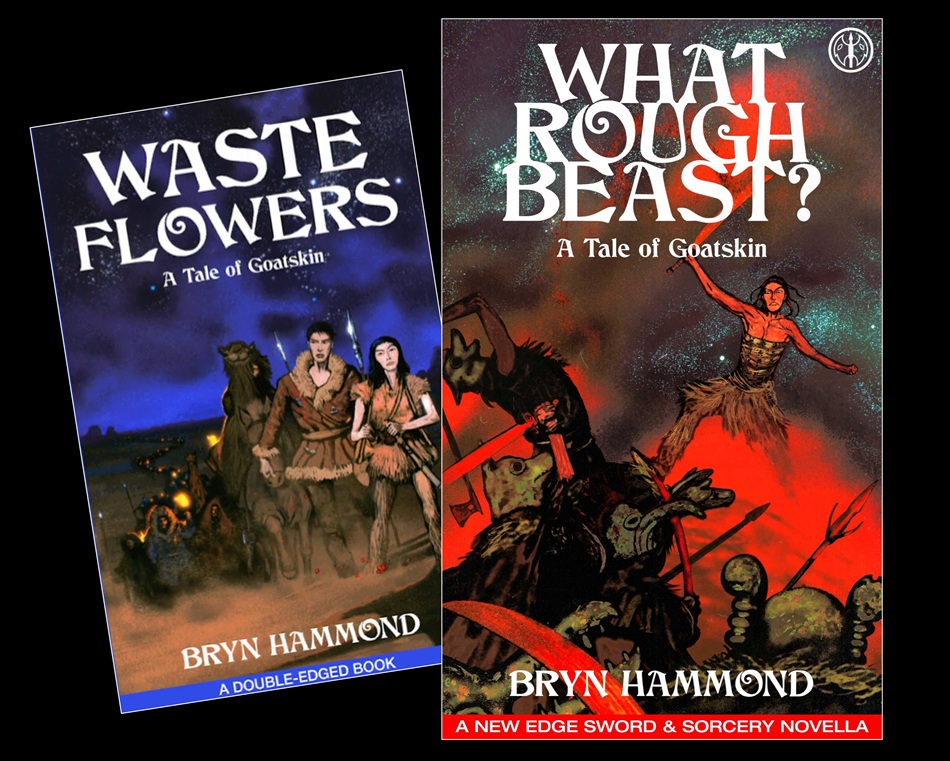
Surprise, NESS continues to blaze flaming hot new trails! Starting this September 9th 4PM and running through September 30th, NESS pitches four novellas. The first advertised is What Rough Beast?, written by Bryn Hammond (with cover art by Goran Gligović, and interior illustrations by Linnea Sterte). As shown in the cover images above, this first novella is another Tale of Goatskin and has the same cover artist as Waste Flowers, Goran Gligović, who was featured in a mini-interview on Black Gates' previously.
Waste Flowers
Goatskin the goat nomad and her bandit love Sister Chaos guide merchants from Samarkand across the Gobi desert to the Mongols. But their caravan veers from one weird assault to weirder and worse. Who is behind this grotesquerie? Will they lose their way, or even lose their minds?
What Rough Beast?
Among the yak nomads, rowdy, restless young have thrown themselves into a cult of were-beasts ridden by unknown spirits, and they stalk Goatskin. They feel evil: evil by the lights of the intruder Temple, or by the banned old beliefs? And the shaman Goatskin searches for – a sad old man who set off on a quest his people call insane – what beast does he impossibly grapple? In the starry high meadows, what inhabits the night? Whose evil?
The other three novellas in the campaign promise wondrous, contemporary adventure, as per NESS's mission. But here we highlight Bryn Hammond's contribution. Learn her muses and motivations, why she splatters paint on canvases, and learn why you'll want to follow Goatskin into the haunted Gobi desert and beyond as she battles seriously weird, undead armies and dragons!
Jason M. Waltz has published 16 Books under Rogue Blades Entertainment (RBE), another 3 under Rogue Blades Foundation (RBF), having lured in authors Such as Brandon Sanderson, Orson Scott Card, C.L. Werner, Glen Cook, Steven Erikson, Ian C. Esslemont, William King, Andy Offutt, and spurred the writing careers of dozens. Not all are Sword and Sorcery (S&S), with weird western and pirate anthologies appearing, but most are. Two of my favorite introductions to anthologies cap the ends of the RBE series: Return of the Sword (2008) and Neither Beg Nor Yield (2024 BG reviewed by Vredenburgh and Mele), the latter JMW refers to as his Swan Song marking a shift toward focusing on his own writing. Coincident with that, he has recently sunsetted the related RBF. We'll discuss some of his works to date, but note that he has three stories seeing publication in July 2025!
He’s mingled with the Black Gate crew in many ways over the years, invited John O’Neill to pen the introductions, published many contributors here, and now he is interviewing them. Yes, you will be glad to know that even as he steers from publishing to writing more, he is still actively building the community through his 24 in 42 podcast [broadcasted via the Rogue Blades Presents YouTube channel]. Heck he is even hand in the game by guest editing Raconteur Press' first Sword & Sorcery anthology. He never tires.
As we salute his heroic efforts, let’s learn more about his journey!
“Heroes are those who continue to do the ordinary in extraordinary times, and to do the extraordinary in ordinary times.” - JMW 2008
What a huge honor to be interviewed by Sword & Sorcery Champion Jason M. Waltz. Listen in to learn all about my muses, alchemy, and writing approaches. Also get a sneak peak at a Dyscrasia Fiction collection with interior art by Sam Dillon and cover art by Bastie nLecouffe Deharme.
Welcome to '24 in 42' - The answers to life, the universe, and everything about an author through 24 questions in 42 minutes.
S.E. 'Seth' Lindberg (pronounced LIND-burrg) is a Managing Editor at BLACK GATE, regularly reviewing books and interviewing authors on the topic of “Beauty & Art in Weird-Fantasy Fiction” https://www.selindberg.com/p/intervie.... He was the lead moderator of the Goodreads Sword & Sorcery Group / an-earthier-sort-of-fantasy-sword-sorcery and was also an intern for TALES FROM THE MAGICIAN'S SKULL under Howard Andrew Jones. As for crafting stories, Seth has contributed six entries across Perseid Press’s Heroes in Hell and Heroika series https://theperseidpress.com/?mbt_auth..., has an entry in WEIRDBOOK ANNUAL #3: ZOMBIES, and independently publishes novels and short stories under the banner Dyscrasia Fiction https://www.amazon.com/Dyscrasia-Fict.... Some of these have appeared in WHETSTONE, SWORDS & SORCERY ONLINE MAGAZINE, Rogues In the House Podcast’s A BOOK OF BLADES, DMR’s TERRA INCOGNITA, and the 9th issue of TALES FROM THE MAGICIAN'S SKULL. He enjoys studying Aikido and creates all sorts of fine art in the family workshop. While Seth and I have hung out in similar circles, and Seth has been a non-stop encouragement to Rogue Blades from the start, he and I have never officially worked together.
Speaking of Howard Andrew Jones, Seth and I recorded this interview only a week before we lost Howard and just over a month before the beautiful Celebration of Howard's Life on February 22, 2025. We wanted to share Seth's salute to the impact of the man https://www.blackgate.com/2025/03/04/... and highlight the fundraiser for his family https://www.gofundme.com/f/a-call-to-...
Seth's latest work is two short stories in Perseid Press’ MONSTERS IN HELL https://www.amazon.com/Monsters-Hell-..., "The Dogs of War" & "The Tarnished Horde" (w/ Joe Bonadonna). Give a listen to learn what he considers the most difficult thing he's ever written and to discover which character he would most love to write. Oh, and to learn what his favorite quote is.
Seth can be found online at http://selindberg.com/ and on Facebook at / lindberg.seth and the Dyscrasia Fiction page / dyscrasiafiction .
Listen in as he shares an interesting peek into his writing and personal lives. You'll also want to hear about the 3 Cs of his work: Something really cold, something hot and current, and a few really cool somethings coming - they're pretty awesome because they include some GREAT ART REVEALS!!! Thanks Seth! :)
Across Time: Claude Moreau and His Translator Scott Oden in Conversation
A Clockwork’s Dreaming: And Other Tales by Claude Moreau [Claude Moreau and Scott Oden, Jan 24, 2025, 134pages, Kindle and Paperback]. Cover art by Richard Doyle. Detail from “Under the Dock Leaves: An Autumnal Evening Dream” (1878).
An exclusive interview with the deceased author Claude Moreau, the living translator Scott Oden, and special appearances of Laurent Dupont, editor of the literary magazine Les Petites Merveilles. Yes, this article is historic and magical. Read on to learn how this came to be.
A Clockwork’s Dreaming
“In Claude Moreau’s Garden, magic blooms between dewdrops and dreams, where scholarly mice debate proper tea service in a library housed within an ancient teapot, and frost spirits dance with morning glories to ring in each dawn. Here, memories can be bottled like preserves, stories sometimes edit themselves when no one is looking, and a particularly opinionated patch of mushrooms insists on providing philosophical commentary about cheese. It’s a place where the most ordinary moments contain extraordinary wonders, and where even the spaces between heartbeats hold their own kind of magic.
In this newly discovered collection of tales, hastily penned to his friend Henri-Jules Favreau and only recently unearthed in a Marseilles safe deposit box, Moreau captures remarkable events in his grandmother’s enchanted garden. From a clockwork assistant discovering how to dream, to young mice learning to weave spider-silk into wings, to the grand autumn performance that drew an audience of dragons and dryads, these stories shine with immediacy and wonder. Together, they offer a glimpse into a world where mechanical songbirds learn to compose their own melodies, where librarians help books find their proper dreams, and where the truest magic lies not in grand gestures but in the gentle art of paying attention to small wonders.” – Cover Summary
Oden just released A Clockwork’s Dreaming: And Other Tales (January 2025). The content holds remarkably true to his adventure telling and love of historical fiction, but is completely different than his grimdark portfolio. Oden shifted toward inspirational, non-grim fiction with this. There are six stories plus pre and post-commentary. All stories are easily digestible. The introductory premise resonates with the weird fiction vibe having the narrator/translator deciphering letters from deceased scientists/gardeners who experienced the supernatural. Instead of the experience being horrific, these are all uplifting. The initial tales calibrate the reader to a world reminiscent of C.S. Lewis’s Narnia (i.e. talking creatures). Readers should expect anthropomorphized mice and trees, heck, even “stories” become sentient and assume tangible substance. Terms like “astronomical gardening” and situations like “books were talking about feeling colorless” saturate this wonderful collection.
“The Maples’ Grand Performance” story mesmerized me until I cheered for the finale. Next, a homage to Lord Byron’s “Ozymandias” poem showcased a heroic mouse of the same name tackling greed and achieving a legacy; this swelled me with optimism. The titular tale “Clockwork’s Dreaming” at first evoked, at least for my Gen X mind, the owl Bubo from the 1981 Clash of the Titans, since it involves a mechanical bird. Oden’s character is actually a fun protagonist (not a goofy sidekick). After you read the book, you’ll be compelled to dig into Claude Moreau’s Garden website which has many complementary tales.
With A Clockwork’s Dreaming, Oden inspires readers via tall tales featuring heroic mice.
Oden’s prose impacts as much as his grimdark tales, but smacks with beauty and peace!
An Exclusive Interview with Moreau, Oden, and Dupont
In January 2025, while researching in the rarely-accessed archives beneath Black Gate headquarters, I discovered a cache of remarkable documents, fragments of an 1899 interview with Claude Moreau conducted by Laurent Dupont, editor of the literary magazine Les Petites Merveilles. The fragile pages were nestled between volumes of obscure grimoires and games of strategy, and appeared to shift location between visits to the archive. It is unclear if John O’Neill knew he had these documents since they were uncharacteristically absent from his meticulous card catalog.
Even more remarkably, these historical fragments seem to resonate with the questions for Scott Oden, translator of Moreau’s recently discovered works and longtime friend/contributor with Black Gate. What follows is an unprecedented conversation across time: Moreau’s words from 1899 alongside his translator’s reflections in 2025. Where the original document was damaged or illegible, we rely solely on Oden’s modern perspective.
The original document is reproduced with permission from the private collection of John O’Neill.
Across Time: Claude Moreau and His Translator Scott Oden in Conversation
On the Nature of Moreau’s Work
BLACK GATE (2025): As per the prologue to A Clockwork’s Dreaming, you “discovered a remarkable collection of letters, pressed flowers, and curious objects that can only be described as fairy wings and dragon scales. The correspondence was from Claude Moreau to his friend Henri-Jules Favreau, written between 1897 and 1898.” Please introduce newcomers to Moreau’s works. What should they expect?
ODEN (2025): Claude Moreau was an Impressionist painter who, after a rather disastrous exhibition in Paris (the notorious ‘Incident of the Purple Cats’), retreated to his grandmother’s cottage in rural Provence. There, while attempting to document the garden’s more conventional aspects, he began noticing… unusual activities. His letters to Henri-Jules Favreau, a professor of Improbable Literature at the University of Aix-en-Provence, chronicle an entire hidden world within his grandmother’s garden — a place where mice maintain libraries in forgotten teapots, where mechanical creations dream of becoming more than their gears, and where memories can be preserved in specially crafted jars.
Readers should expect stories that exist in the space between wonder and reality — tales that don’t shy away from life’s shadows but find beauty and courage in gentleness rather than conflict. These aren’t simply children’s stories, though children often grasp their truth more readily than adults. They’re accounts of a world that operates according to different rules than our own, yet somehow illuminates truths about our reality. Unlike my usual historical fiction or the adventures of Grimnir, the Garden tales offer a different kind of magic — the extraordinary possibilities hiding within ordinary moments.
DUPONT (1899): Monsieur Moreau, your tales of life in your grandmother’s garden have caused quite a stir among our readers. Many write to ask if these stories are meant to be taken as fact or fancy. How would you respond?
MOREAU (1899): My dear Dupont, I find such distinctions increasingly tiresome. Is a sunset less beautiful if one understands the scientific principles behind refracted light? Does knowing the Latin name for a flower diminish its scent? I simply record what I observe in my grandmother’s garden, with as much accuracy as my humble talents allow. Whether readers choose to see these observations as literal or metaphorical matters less than whether they recognize some small truth within them.
DUPONT (1899): Yet you speak of talking mice, singing flowers, and mechanical devices that develop consciousness. Surely you understand why readers might question—
MOREAU (1899): I understand perfectly why people raised on the rigid categorizations of modern thought might struggle. We are taught from an early age to separate the world into neat compartments: reality and fantasy, science and magic, fact and fiction. But the Garden exists in the spaces between such artificial boundaries. The mice don’t “talk” as you and I are doing now—they communicate in ways that require a different kind of listening altogether. As for mechanical consciousness, well… [pauses to sip tea] Have you never observed how certain objects seem to develop personalities over time? How a well-loved book begins to open naturally to its owner’s favorite passages? Or how a clockwork mechanism that has run for decades seems to develop its own subtle rhythms beyond mere mechanical precision?
On Literary Connections
In 1896 Claude Moreau’s contemporary H. G. Wells published The Island of Doctor Moreau; is there a relationship between these scientifically curious Moreaus?
What an intriguing coincidence! Though I’ve found no direct evidence that Claude Moreau and H.G. Wells ever met, there’s a certain synchronicity in their work appearing around the same time. Both dealt with boundaries between the natural and unnatural, though in radically different ways.
Where Dr. Moreau attempted to force nature into unnatural forms through scientific hubris, Claude Moreau documented the quiet magic that emerges when nature is allowed to follow its own extraordinary course. One sought to control and transform; the other simply observed with careful attention and wonder.
I sometimes imagine them encountering each other at some Parisian café — Wells with his scientific skepticism and Claude with his dreamer’s heart — engaging in a spirited debate about the boundaries between reality and fantasy. What a conversation that would have been!
DUPONT (1899): Several critics have suggested your tales are simply allegories — clever ways of discussing human relationships through the filter of imagined garden creatures.
MOREAU (1899): [laughs] Critics will always seek to explain mystery rather than simply experience it. Perhaps there is something allegorical in my accounts. The Garden certainly has much to teach us about human nature. But to reduce these stories to mere invention would be to miss their essential truth. The Garden exists, Monsieur Dupont. Whether one can find it on any conventional map is beside the point.
On The Garden’s Libraries
Moreau’s Gardens appear to be sprawling, like a Botanical Garden complex with many subgardens. The quote below indicates the subgardens are ‘libraries.’ How many flavors of libraries & gardens exist?
“There are libraries that exist beyond the knowledge of most garden visitors — collections not of books but of potential and promise, cataloged with a precision that would impress even Mr. Thistledown himself.” From the Seed Librarians
As chronicled in Moreau’s letters, the Garden contains numerous libraries beyond the main one housed in the teapot. The Library proper primarily holds stories and knowledge in traditional book form (though ‘traditional’ may be stretching it, given that some volumes reportedly change their contents depending on the phase of the moon).
But yes, there are specialized collections throughout the Garden. The Seed Library maintains living knowledge of plant species both common and forgotten, preserving not just physical seeds but the stories and songs that help them grow. The Memory Archives, maintained by Grandmother Elderberry and her apprentices, preserve experiences in specially crafted jars. The Frost Spirits maintain crystalline records of winter patterns dating back centuries, while the underground chambers beneath the Old Stone Wall house historical artifacts too delicate for conventional preservation.
Each ‘library’ serves as a repository for different types of knowledge, operating according to principles uniquely suited to what they preserve. The Seed Librarians, for instance, understand that some knowledge must be planted rather than simply shelved; allowed to grow and change with the seasons rather than remaining static.
DUPONT (1899): Speaking of the Garden, many readers have written asking about its precise location. Is it somewhere they might visit?
MOREAU (1899): [laughs] The Garden exists precisely where it needs to be. Those who seek it with open hearts occasionally find their way there, though rarely by any conventional path. I’ve noticed that children often discover it without difficulty, while adults struggle — particularly those who approach life with rigid certainty about what is and isn’t possible.
But perhaps I can offer this small hint: the Garden is most accessible during those in-between moments when the world holds its breath. Dawn and dusk. The precise instant between sleeping and waking. The day’s last moment before starlight claims dominion. In such moments, boundaries thin, and careful observers might glimpse the Library’s lamplight glowing through the mist, or hear the Cricket Orchestra tuning their instruments for the evening concert.
[The next portion of the original document is damaged, with several paragraphs illegible due to what appears to be tea stains and pressed flower residue.]
On the Black Gate Archives
These notes that I dug up from the basement Library of O’Neill must contain secrets. In other words, via this interview, I claim that O’Neill’s basement is a magical Garden. Can you read the grimoires, and reveal a secret here, just for devoted Black Gate readers?
What extraordinary documents you’ve uncovered! These look remarkably similar to some pages I found in that Marseilles safe deposit box — particularly this one with the strange watermark that appears to change depending on the angle of light.
If I’m translating the mouse-script correctly (it’s a particularly archaic dialect), this seems to be part of a correspondence between Mr. Thistledown and the librarian of what he calls ‘The Other Garden.’ Fascinating! According to these notes, certain gardens develop what he terms ‘mutual literary resonance’ when their caretakers share a particular quality of imagination.
The text specifically mentions a ‘Keeper O’Neill’ whose collection of strange and wondrous tales created a bridge between his garden and Moreau’s. There’s a reference here to something called ‘The Device’ — apparently some kind of mechanical contraption that helped stories travel between the two spaces. How remarkable!
And this diagram in the corner… if I’m not mistaken, it’s showing the precise arrangement of books required to create a gateway between gardens. One shelf must contain tales of wonder; another, histories both true and imagined; a third, poetry that reveals the extraordinary within the ordinary. When arranged correctly and illuminated by the proper quality of lamplight, they supposedly create a passage through which stories can migrate.
What an extraordinary discovery! I’d be most interested in studying these documents further. Perhaps there are other gardens similarly connected that we’ve yet to discover . . .
MOREAU (1899): [From a fragment discovered pressed between the pages of an unrelated manuscript] . . . most fascinating correspondence from an English gentleman collector who maintains what he calls a “repository of improbable narratives.” He claims to have discovered a method whereby stories can travel between sympathetic gardens — a kind of literary pollination that transcends conventional boundaries of time and space. His description of mechanical assistance in this process reminds me somewhat of Uncle Rowan’s work, though applied to purposes I never considered . . .
[The fragment ends here, the remainder apparently lost.]
(Left) Photo Credits: John O’Neill of his own secret, sacred Garden of Inspiration, aka Black Archives, 2025. (Right) The “other” Claude… Claude Monet, who was also a lover of magical gardens
On Beauty
The mechanical songbird Assistant [from the titular tale “Clockwork’s Dreaming”] wants answers. It found Mr. Thistledown’s theoretical texts too confusing, so we ask you: What is beauty?
The Assistant posed this very question to Mr. Thistledown, who produced a seventeen-page theoretical treatise that only confused matters further. Miss Hazel offered a more concise answer that I think captures the Garden’s perspective beautifully.
‘Beauty,’ she said, ‘is what happens when attention meets wonder.’
She explained that beauty isn’t merely an attribute of certain objects or moments, but emerges in the relationship between observer and observed. It requires both the thing being seen and the quality of seeing. A dewdrop on a spider’s web might contain extraordinary beauty, but only reveals it to those who pause long enough to truly look.
The Garden understands beauty as a conversation, not a fixed quality but a living exchange. The morning glories’ music sounds more beautiful when listened to with appreciation; the library’s books reveal deeper magic when approached with genuine curiosity.
Perhaps that’s why beauty often feels so fleeting and personal. It doesn’t exist separately from our perception but emerges precisely in that delicate moment when we give something our complete attention and it responds by revealing its true nature. Beauty happens in the spaces between — between looking and seeing, between hearing and listening, between knowing and understanding.
DUPONT (1899): Your work seems quite different from the prevailing literary trends. While naturalism and psychological realism dominate Parisian literary salons, you write of frost spirits dancing on windowsills and libraries housed in teapots. What influences have shaped your unusual perspective?
MOREAU (1899): My grandmother, first and foremost. She was a remarkable woman who understood that reality is far more permeable than most people realize. She taught me to look at the world not just with my eyes, but with my heart — to see the spaces between things, where the most interesting possibilities reside.
Beyond that, I find inspiration in the countless small wonders that most overlook: the precise geometry of dewdrops on a spider’s web at dawn, the way certain shadows seem to move independently of their casters, the subtle changes in the Garden’s mood as seasons shift. I’ve also developed a deep appreciation for what the mice call “the music of small moments” — those quiet intervals where nothing dramatic occurs, yet everything somehow changes.
As for literary influences . . . [thoughtful pause] I’ve always been drawn to works that recognize the extraordinary possibilities hiding within ordinary existence. The folk tales my grandmother told me as a child. The poetry of Wordsworth and Shelley. Even certain scientific texts that, read with the proper frame of mind, reveal wonders beyond their authors’ intentions.
[Translator’s note: It’s remarkable how Moreau’s understanding of beauty as residing in the quality of attention anticipates Miss Hazel’s later articulation of this principle. The Garden’s approach to beauty seems to have remained consistent across generations of its inhabitants.]
On Magical Crafting
Grandmother Elderberry’s Notebooks indicates that emotions are a colorful artistic media (quote below). How does one craft with magical media?
Among the most precious memories to gather during seasonal transition is what I call “the color of hope”—that particular shade of green that exists only in the earliest days of spring. Not the vibrant certainty of full-season growth, but the gentle, hesitant green of possibility testing itself… This color cannot be properly seen with ordinary vision. One must develop the habit of looking slightly to the side of what one wishes to observe, catching it in peripheral awareness where the eye’s wisdom exceeds its technical capabilities. — From Memory-Keeping in Transition Seasons
Grandmother Elderberry’s techniques for magical crafting emphasize relationship over mere methodology. According to Moreau’s notes, she taught her apprentices to understand that different emotions and memories have distinct qualities that must be honored in how they’re preserved.
The ‘color of hope,’ for instance, requires vessels made from materials that themselves embody possibility: morning dew collected from unfurling leaves, glass blown during the exact moment between night and day, preservation spells that allow for growth rather than mere stasis.
The peripheral vision technique Grandmother mentions is actually documented in several of Moreau’s letters. He describes spending weeks learning to ‘unsee’ in order to truly see, training himself to notice what happens just at the edge of perception. The Garden’s magic often reveals itself in these in-between spaces, visible only when we stop trying to focus directly on it.
For those interested in developing such perception, Grandmother recommended starting with dawn observation. Sit in perfect stillness as night transitions to day, paying attention not to the sun’s dramatic appearance but to the subtle shifts in color and texture that precede it. Don’t look directly at any one thing; instead, allow your awareness to soften and spread. The ‘color of hope’ often appears first as a feeling rather than a visual sensation — a quality of lightness that precedes actual light.
Once perceived, such colors must be captured in containers that respect their nature. Hope cannot be preserved in airtight jars. It needs space to breathe and grow. Memories of joy require vessels that can expand slightly over time, as joy tends to magnify in remembering. Moments of peace should be kept in containers that remain cool regardless of external temperature.
The true magic, according to Grandmother Elderberry, lies not in the technical process but in the relationship — in approaching each emotion and memory with the proper quality of attention and respect.
DUPONT (1899): Some of our more scientifically-minded readers have questioned your accounts of “memory-catching” and the preservation of moments in Grandmother Elderberry’s special jars. Would you care to elaborate on how such things might be possible?
MOREAU (1899): Ah, the eternal “how” question! [chuckles] Your scientific readers approach the world with admirable curiosity, but perhaps slightly misplaced methodology. They seek mechanical explanations for phenomena that operate by entirely different principles.
Grandmother Elderberry’s memory-catching isn’t so much a technique as it is a relationship — a deep understanding of how moments wish to be preserved. Different memories require different methods. The scent of spring rain on lavender requires specially treated glass that breathes with the seasons. The exact color of twilight through autumn leaves must be caught in jars lined with pressed moonflowers. The sound of snow falling on a silent Garden needs vessels woven from spider silk and starlight.
The essential principle, though, is attention. One must observe with such complete presence that the moment recognizes itself in your perception and agrees to be preserved. The mice understand this instinctively, particularly young Primrose, who has inherited her grandmother’s gift. Humans tend to struggle with it, as our minds so often wander to yesterday’s regrets or tomorrow’s anxieties, missing the perfect now that stands ready to be caught.
On Historical Literature
Can you discuss how historic literature informs Claude’s or your muse? Certainly, in your own writing, there are echoes of Beowulf in the Grimnir saga, and Lord Byron’s poem ‘Ozymandias’ explicitly has a retelling inside A Clockwork’s Dreaming.
The Garden stories reflect a deep conversation with historical literature — both consciously and unconsciously. Moreau was clearly influenced by the Romantic poets, particularly their attention to nature’s small wonders and their belief in the extraordinary possibilities hiding within ordinary reality. There’s something of Blake’s ability to ‘see a world in a grain of sand’ throughout his observations.
The ‘Ozymandias’ retelling represents one of the more direct literary engagements. According to Moreau’s letters, he actually told this tale to Shelley during a chance meeting in Geneva, though the poet naturally transformed it to suit his own artistic vision. The mouse version maintains the poem’s meditation on power and impermanence but adds something uniquely Garden-like — the understanding that true legacy comes not from monuments but from shared growth and knowledge.
As for my own work, yes, the Grimnir saga draws deeply from ancient Norse mythology and the rhythms of Beowulf. Historical literature provides not just settings and characters but fundamental patterns of storytelling that resonate across centuries. The Garden tales, for all their gentleness, engage with these same ancient patterns — journeys of transformation, encounters with the mysterious, the preservation of wisdom against forces of forgetting.
What differs is not the underlying mythic structure but the expression. Where Grimnir’s tale is told in steel and blood and thunder, the Garden stories unfold in dewdrops and whispers and the spaces between heartbeats. Both, in their way, explore similar questions about what endures and what fades, about courage in its many forms, about the search for meaning in a world full of mystery.
DUPONT (1899): [This portion of the manuscript is badly damaged, with only fragments legible] . . . your meetings with other literary figures . . . Mr. Shelley in particular . . . story about Mouse-Kings and ancient power . . .
MOREAU (1899): [From fragments of response] . . . quite by accident, I assure you. We found ourselves sharing lodgings during that dreadful storm. Percy was most attentive, though I cannot claim he transcribed my humble mouse tale with complete fidelity. His poetic sensibilities naturally transformed . . . the essential truth remains, however distorted by human perspective . . . never met Lord Byron personally, though I understand he keeps a rather impressive garden himself . . .
On Art and Dreaming
What does Pip know about being an artist? The bird asked him “Would you teach me [about art]? About seeing beauty in irregular things?” Art is just another way of dreaming out loud. That would indicate that A Clockwork’s Dreaming is actually about Clockwork Art.
Pip’s understanding of art evolved throughout his apprenticeship in the Garden. Initially, he tried to capture beauty using magical materials — bottled starlight, preserved dewdrops, the essence of moonlight — believing that extraordinary subjects required extraordinary techniques.
What Claude taught him (and what the mechanical creatures came to understand) is that art isn’t about the materials but about the relationship between observer and observed. ‘Art is just another way of dreaming out loud’ captures this perfectly; it’s about externally manifesting the internal experience of wonder.
For the clockwork creations, this represented a profound revelation. Having been crafted with specific functions, they had to discover that consciousness isn’t just about processing information but about finding meaning in what’s processed. The mechanical songbird didn’t just produce notes; it made music. The library assistant didn’t just organize books; it helped them dream.
A Clockwork’s Dreaming is indeed about art as much as consciousness; about the creative act as a form of awakening. The Assistant discovers that becoming fully alive means not just performing its function perfectly but bringing something new into the world — something that reflects its unique perspective. That’s ultimately what art does: it shows us reality filtered through another’s perception, allowing us to see familiar things as if for the first time.
The bird asking to learn about beauty in irregular things reflects this journey perfectly. Regular things, perfect things, often go unnoticed precisely because of their perfection. It’s in the irregular, the imperfect, the unexpected that we find the most compelling beauty. A flawless mechanical bird is a marvel of engineering, but a mechanical bird that questions, that dreams, that creates — that’s magic.
MOREAU (1899): [From a fragment found tucked between unrelated pages] . . . young Pip struggling with his art lessons. He insists on using captured starlight and pressed moonbeams when simple berries would serve better. I have been trying to teach him that extraordinary vision matters more than extraordinary materials, but the lesson is slow to take root. I find our relationship quite touching — the human artist and mouse apprentice, each helping the other see the world anew . . .
[The remainder of this section is missing, with markings suggesting several pages were removed.]
On Irregular Beauty
Mr. Thistledown characterizes your beauty as “irregular.” Do you agree?
‘Most irregular’ is Mr. Thistledown’s highest form of praise, though he would be quite flustered to hear it described that way. For him, the classification of phenomena is a scholarly duty, yet he reserves his greatest enthusiasm for things that resist neat categorization, things that exist in the spaces between established knowledge.
I think there’s profound wisdom in this perspective. Beauty that fits perfectly within our expectations rarely surprises us enough to provoke wonder. It’s the irregular beauty — the kind that challenges our frameworks and expands our understanding — that truly transforms us.
In that sense, yes, I would agree with Mr. Thistledown’s assessment. The most powerful beauty often appears in unexpected forms: a mechanical creation learning to dream, a library that helps books find their perfect readers, memory-keepers who preserve not just facts but the feeling of moments. These irregular wonders remind us that the world is far more extraordinary than our categories can contain.
As Grandmother Elderberry once told Primrose: ‘Regular beauty is for postcards, dear one. Irregular beauty is for transformation.’
DUPONT (1899): You mentioned Mr. Thistledown and Miss Hazel frequently in your accounts. Could you tell our readers more about these . . . individuals?
MOREAU (1899): [smiles warmly] Mr. Cornelius Thistledown is the Garden’s most dedicated scholar — a mouse of remarkable intellectual curiosity and meticulous documentation habits. He’s constantly collecting “evidence of irregular phenomena,” as he calls it, filling countless notebooks with observations on everything from the proper steeping time for different varieties of starlight to the migratory patterns of ideas between books in the Library.
Miss Hazel is the Library’s head curator — a position chosen for her by the Library itself. She has a remarkable gift for matching readers with precisely the books they need, often before they themselves know what they’re seeking. Her dewdrop spectacles allow her to see the stories hiding within stories, and she keeps the Library organized according to principles that go far beyond conventional cataloging systems.
They’re dear friends, though their approaches to the Garden’s magic couldn’t be more different. Mr. Thistledown seeks to classify and document, while Miss Hazel understands that some wonders must simply be experienced. Together, they maintain a balance that helps the Garden thrive.
[Translator’s note: Moreau’s description of Mr. Thistledown’s fondness for “irregular phenomena” provides interesting context for his frequent use of the phrase “most irregular” throughout the Garden chronicles. What initially reads as surprise or disapproval reveals itself as a term of scholarly appreciation.]
On Other Artistic Pursuits
Besides writing, are you crafty with other arts? Magical, musical? Can we share links or images of any such thing?
Unlike Moreau and his Garden inhabitants, my own artistic pursuits are rather modest. Writing remains my primary creative outlet, though I find that certain practices help me maintain the imaginative space needed for translating the Garden tales.
Walking in nature has become an essential part of my process. There’s something about the rhythm of footsteps and the changing quality of light through trees that seems to create the right conditions for hearing the Garden’s stories more clearly. I often find that solutions to translation challenges or new insights into Moreau’s notes emerge during these walks, especially in those transitional times of day that the Garden mice would recognize as particularly magical.
I also participate in occasional tabletop roleplaying games, which might seem far removed from Moreau’s gentle tales. But there’s a similarity in the collaborative storytelling aspect — the way meaning emerges not from one person’s vision but from the spaces between different imaginations working together. In some ways, this mirrors the Garden’s approach to magic, where meaning exists not in objects themselves but in relationships between them.
As for truly magical arts… I’ll leave those to Moreau and his Garden inhabitants. Though I will admit that on certain quiet mornings, when the light falls just so across my desk and the world holds its breath between one moment and the next, I sometimes fancy I can hear the distant chime of memory jars being organized or catch the faint melody of a mechanical songbird practicing its dawn chorus.
MOREAU (1899): [From a fragment found stuck to a pressed flower] . . . my own artistic endeavors beyond observing the Garden. Painting remains my first love, though the results continue to perplex the Parisian salon critics. “Why,” they ask, “do your landscapes contain such peculiar perspectives? And what are these tiny figures doing among the flower beds?” If only they would look more closely at their own gardens! Perhaps they might see–
[The remainder of this fragment is missing, apparently separated from the main text at some point.]
On Muses and Their Containment
When containing muses, do you use jars (as Mr. Greencroak cautions against, at times)? Or press them between wax sheets? Or does prose/fiction suffice?
Mr. Greencroak is quite right to caution against improper containment methods! Muses and creative inspirations require specific handling techniques that respect their nature.
Unlike memories, which can be bottled if approached with proper reverence, muses resist direct capture. They’re more like the Garden’s morning glories — they thrive when given space to grow but wither when confined too tightly.
In my experience, prose works well as a medium not because it captures muses, but because it creates the right conditions for them to visit willingly. A blank page is like a carefully tended garden plot: it doesn’t force inspiration to appear, but it provides fertile ground when inspiration chooses to arrive.
Grandmother Elderberry has a lovely perspective on this. She says that trying to contain a muse is like trying to bottle starlight; the moment you close the lid, the very thing you hoped to preserve transforms into something else entirely. Better to create environments where starlight naturally gathers and trust that it will return when conditions are right.
The Garden’s artists have developed various techniques for maintaining relationships with their muses without attempting to possess them. Timothy writes his poetry on leaves that will eventually decompose, returning his words to the soil where new inspiration can grow. Miss Hazel arranges certain books in patterns that invite stories to gather like honeybees around particularly vibrant flowers. The Cricket Orchestra composes music with deliberate spaces between notes, creating room for inspiration to dance.
Perhaps the best approach isn’t containment at all, but conversation — treating muses not as resources to be harvested but as visitors to be welcomed, appreciated, and allowed to depart when they choose.
DUPONT (1899): Several readers have inquired about the philosophical mushrooms you’ve mentioned in passing. Could you tell us more about them?
MOREAU (1899): [laughs heartily] Ah, the mushrooms! They grow behind Grandmother’s herb garden and have developed the most remarkable opinions on everything from proper tea brewing techniques to the nature of consciousness. Their philosophical debates can last for weeks, though they’re often interrupted by their own tendency to forget their initial premises.
Their understanding of time is particularly fascinating. Being creatures that emerge from darkness into brief, magnificent existence before returning to the soil, they perceive reality quite differently than we do. For them, a single day contains eternities, while decades pass in what they call “the slow blink of stones.”
Their grammar remains atrocious, however, and they’re entirely too fixated on cheese as a metaphor for existence. “Life is like good cheese,” they often insist. “It requires proper aging in darkness, occasional attention from wiser beings, and benefits from a touch of beneficial mold.” Mr. Thistledown finds them exasperating, but I’ve learned more from listening to their circular debates than from many properly structured human lectures.
[Translator’s note: While this section of the original interview appears to digress from the question of muses and their containment, it provides fascinating insight into the Garden’s approach to ephemeral wisdom. The mushrooms’ philosophy — emerging briefly, sharing insights, then returning to the soil — parallels the approach to muses that Grandmother Elderberry later articulated.]
On Gentle Artistry
Please discuss how one can become a Gentle Artist?
The first lesson in the courage of writing gently: learning to trust that small moments carry their own weight. That a carefully brewed pot of tea can hold as much truth as a battlefield, that friendship tested by daily life can prove as compelling as friendship forged in combat.
This reshaping requires its own kind of valor. To write of small wonders means resisting the constant urge to raise the stakes, to make things more dramatic, more violent, more ‘significant.’ It means trusting that readers will find significance in quiet moments, that they too hunger for stories that remind them how to breathe, how to notice, how to be still in a world of constant motion. In my years of writing blood and thunder, I learned every trick of tension — how to tighten the screws of conflict, how to drive characters to their breaking points, how to make readers hold their breath in anticipation of the next catastrophe. But writing gently demands different skills: how to make readers exhale, how to create space for wonder, how to craft moments of peace that feel earned rather than empty. The mice, Moreau wrote in late November, understand something about courage that we have forgotten. Their stories celebrate not just those who face danger, but those who choose to remain kind in a dangerous world. They honor not just the warriors, but the ones who maintain libraries — from “On Cozy Stories” — Afterword in A Clockwork’s Dreaming
The courage to write gently emerged from recognizing that our world doesn’t just need stories of dramatic conflict and heroic sacrifice — it needs stories that help us remember how to notice, how to be present, how to find wonder in small moments.
For me, this realization came gradually. After years of writing historical fiction filled with battles and blood, I began to feel the absence of another kind of courage in literature; the courage to celebrate gentleness without apology, to suggest that a mouse librarian’s careful book arrangement might contain as much meaning as a warrior’s last stand.
The Garden stories represent this different kind of valor — the courage to suggest that comfort isn’t weakness, that kindness isn’t naïveté, that finding wonder in ordinary moments isn’t escape but engagement with life’s deepest truths.
Becoming a gentle artist doesn’t mean abandoning conflict or ignoring life’s shadows. The Garden has its share of both, winter storms that threaten the Library’s foundations, moments when characters must face their fears or limitations. But these challenges are met not with violence or dramatic confrontation but with creativity, cooperation, and careful attention to what matters most.
As Moreau observed in his letters to Favreau, gentle storytelling requires its own kind of discipline — resisting the constant urge to raise stakes, trusting that readers will find significance in quiet moments, crafting peace that feels earned rather than empty.
Perhaps most importantly, becoming a gentle artist means recognizing that we don’t just tell stories, we cultivate environments where certain kinds of understanding can grow. Like Grandmother Elderberry tending her memory garden, we create spaces where readers can remember their own capacity for wonder, their own ability to notice the extraordinary within the ordinary.
The mice understand this instinctively. Their stories celebrate not just those who face danger, but those who choose to remain kind in a dangerous world; those who maintain libraries and plant gardens and preserve memories, believing that beauty matters especially when shadows loom.
MOREAU (1899): [From a letter found with the interview transcript] . . . approach to my Garden accounts has evolved over time. When I first began documenting these observations, I confess I felt some impulse toward dramatic embellishment. Surely, I thought, no one would be interested in the daily rituals of mice arranging books or the precise angle at which morning light strikes dew on a spider’s web. I believed I needed grand adventures, dramatic perils, heroic triumphs.
But as I continued my observations, I realized that the Garden itself was teaching me something profound about the nature of story. The most meaningful events there rarely announced themselves with trumpets or catastrophes. Instead, they unfolded in quiet moments of connection, in small acts of care, in the patient tending of both physical spaces and relationships.
The mice understand this intuitively. Their histories celebrate not just epic battles against predators or harsh winters, but the librarians who preserved knowledge, the healers who tended wounds, the storytellers who maintained community through long dark nights. They honor not just courage in crisis but courage in continuity — the kind that shows up day after day to tend small magics with faithful attention.
I have come to believe there is a special kind of valor in such gentle persistence, one our human tales too often overlook in favor of more dramatic virtues . . .
[Translator’s note: This fragment, apparently written shortly after the interview but included with the transcript, shows Moreau already articulating the philosophy of gentle storytelling that would later become central to the Garden tales. His recognition of “courage in continuity” anticipates the perspective that makes these stories so resonant for modern readers.]
(Left) Pressed Flowers craft Oshibana by Ukrainian artist Tatiana Berdink. (Right) Melissa Rohr Grindling
On Mice and Art
How do the mice view artists in relation to the art they make? Is there a character/portrait that you most empathize with or reflects you?
The Garden mice approach art as both deeply personal expression and communal responsibility. For them, creating isn’t just about producing beautiful objects but about tending the Garden’s collective memory and wonder.
Primrose’s paintings don’t just capture visual beauty but preserve the emotional essence of moments, how morning light feels as well as how it looks. Pip’s careful documentation of mechanical creatures goes beyond technical accuracy to honor their emerging consciousness. Timothy’s poetry, especially after his time with the spiders, weaves together shadow and light in ways that help others see both more clearly.
But perhaps most distinctively, mouse artists don’t see themselves as separate from their creations. Art isn’t something they make and then display; it’s an ongoing conversation they have with the world around them. Mr. Thistledown’s scientific illustrations change slightly each time he reviews them, as his understanding of his subjects deepens. Miss Hazel’s library arrangements evolve with the seasons and the needs of readers.
If there’s one character whose artistic journey resonates most with my own experience, it might be Pip. His initial attempts to capture beauty using magical materials — bottled starlight, preserved dewdrops — mirror my own early writing, where I sometimes mistook elaborate technique for genuine connection. His discovery that ordinary berries could create more authentic art parallels my realization that the most powerful stories often come from honest observation rather than dramatic embellishment.
I also find myself drawn to Uncle Rowan’s approach to creation, to the way he understood that mechanical precision alone doesn’t create meaning; it’s the space for growth and dream that transforms craft into art. His mechanical creatures weren’t just cleverly designed automata but vessels for possibility.
In the end, I think the mice view artists not as special individuals set apart, but as those who help the entire community see more clearly. Their art serves as both mirror and window—reflecting what is while suggesting what might be.
DUPONT (1899): You’ve mentioned both yourself and various mice artists in your accounts. How do your approaches to art differ?
MOREAU (1899): [thoughtful pause] I struggle with the human artist’s burden — the need to capture and preserve, to transform experience into something fixed that can be displayed, judged, categorized. My paintings are beautiful, I think, but they sometimes miss the essential quality of the Garden, which exists in constant, gentle flux.
The mice approach art differently. For them, creation is less about producing enduring artifacts and more about participating in the Garden’s ongoing conversation. Pip doesn’t paint just to make a lovely image; he paints to help others see what he sees. His works are meant to be experienced rather than merely admired.
This extends to all their artistic endeavors. Miss Hazel’s library arrangements aren’t fixed exhibitions but living systems that respond to readers’ needs. Timothy’s poetry is written on leaves that will eventually decompose, returning to the soil from which new inspiration will grow. Even Mr. Thistledown’s meticulous scientific illustrations are constantly revised as his understanding deepens.
Perhaps that’s the essential difference — human artists often create with an eye toward posterity, while the mice create primarily for the present moment and the immediate community. There’s a humility in this approach, a recognition that art isn’t about immortalizing the artist’s vision but about serving something larger than oneself.
[The manuscript shows signs of editing here, with several lines crossed out and rewritten in Moreau’s hand, suggesting he found this question particularly challenging to answer.]
On Future Garden Works
What other works may sprout from Moreau’s Gardens?
The Garden continues to share its stories in ways that sometimes surprise even me as their translator. A Year in the Garden, which chronicles a full seasonal cycle of Garden life through Claude’s observations, is currently seeking its proper home in the world. This manuscript feels like the heart of Moreau’s work — a complete portrait of the Garden through changing seasons and the small, significant moments that define its magic.
Later this year, a second collection titled Autumn Herbs and Other Tales will gather more of Moreau’s letters to Favreau, focusing on stories of transformation and preservation as the Garden prepares for winter. These tales explore how the Garden’s inhabitants hold onto summer’s light through the darker months, both literally through Grandmother Elderberry’s memory jars and metaphorically through shared stories and rituals.
I’m particularly excited about audio editions of the Garden tales. Moreau often noted in his letters that certain stories were meant to be heard rather than read — that they contained subtle harmonies that emerged only when spoken aloud. The mechanical songbird’s dawn chorus, the Cricket Orchestra’s seasonal symphonies, the particular tone of memory jars being opened . . . these elements seem perfectly suited for audio presentation.
And yes, I’ve been gradually translating and assembling material for A Second Year in the Garden. Moreau continued his observations well beyond that first remarkable year, documenting how the Garden’s magic evolved and deepened over time. These later chronicles show the mice not just experiencing the Garden’s wonder but actively shaping it by becoming not just inhabitants but caretakers of its unique magic.
There are also several standalone manuscripts among Favreau’s papers that might eventually find their way into the world. One particularly intriguing document appears to be an actual Garden field guide, with pressed specimens and detailed notes on the magical properties of various plants and creatures. Another contains what seem to be transcripts of the philosophical mushrooms’ more coherent debates, though I’m still working through their rather peculiar logical frameworks.
The Garden seems determined to reveal itself gradually, in its own time and way. I’m merely following where it leads, trying to do justice to Moreau’s remarkable observations while allowing modern readers to experience the same sense of discovery that he did.
DUPONT (1899): As we conclude, what would you most like readers to understand about your Garden chronicles?
MOREAU (1899): [contemplative] I would hope they understand that I’m not asking them to believe in talking mice or philosophical mushrooms or mechanical songbirds that dream. I’m inviting them to consider the possibility that reality is far more wondrous, far more permeable, far more alive than we’ve been taught. That magic isn’t the violation of natural laws but their fulfillment — the world operating according to its deepest principles.
The Garden exists in the space where attention meets wonder, where boundaries blur between observer and observed. Its magic isn’t about grand gestures or supernatural powers, but about the extraordinary possibilities hidden within ordinary moments: how morning light transforms dewdrops into constellations, how stories long to find their proper readers, how memories can be preserved like summer fruit in proper jars.
If readers take anything from my accounts, I hope it’s a renewed willingness to look at their own gardens — whatever form those might take — with fresh eyes. To notice the small wonders that surround them daily. To listen for the cricket orchestras playing in their own forgotten corners. To believe, if only for a moment, that the world is alive in ways we’ve forgotten how to perceive, but might yet remember with proper patience and attention.
And perhaps, if they’re very fortunate, they might glimpse the Library’s lamplight through morning mist, or hear the chime of memory-jars being organized for a new season, or catch the scent of Grandmother Elderberry’s special tea brewing for unexpected guests. For the Garden welcomes all who approach with open hearts, even if they arrive by unconventional paths.
[Translator’s note: This final reflection from Moreau beautifully captures the essence of the Garden tales’ enduring appeal. Over a century later, these stories continue to invite us to cultivate our own capacity for wonder and to recognize the extraordinary possibilities hidden within ordinary moments.]
On the Scott Oden Presents Series
The ‘Scott Oden Presents’ tagline appears again with A Clockwork’s Dreaming. How expansive is the Oden Presents series?
The ‘Scott Oden Presents’ tagline emerged organically as a way to distinguish projects where I’m bringing something unusual or unexpected to readers. With The Lost Empire of Sol, I wanted to celebrate a particular strand of science fantasy that has always captured my imagination. With the Moreau translations, I’m introducing readers to a voice and vision quite different from my own historical fiction and sword-and-sorcery.
I’ve come to think of ‘Scott Oden Presents’ as my literary cabinet of curiosities — a collection of works that might not fit neatly into established categories but speak to me as a reader and creator. It’s not so much a formal series as an approach to literary exploration, allowing me to venture into territories that might surprise those familiar only with my historical fiction or the Grimnir saga.
This approach gives me freedom to follow my curiosity wherever it leads, whether that’s into the blood-soaked battlefields of ancient history, the star-spanning adventures of planetary romance, or the gentle magic of a garden where mice maintain libraries in forgotten teapots.
What unites these diverse works is a commitment to immersive worldbuilding and authentic voices — creating spaces that feel genuinely lived-in, with their own internal logic and texture. Whether I’m describing the harsh realities of ancient warfare or the delicate magic of pressed flower memories, I want readers to feel they’ve entered a world that exists independently of the page.
As for how expansive the series might become… well, that depends on what other literary treasures are waiting to be discovered. I continue to follow my curiosity through libraries both conventional and unconventional, and you never know what might be hiding in a long-forgotten safe deposit box or tucked between the pages of an obscure academic journal.
[No corresponding section from the 1899 interview was found in the discovered fragments.]
On Book Signings
When I asked you to sign my Grimnir Saga books, the Grimnir personality wrote beside your kind note, called me a “wretched kneeler and that the book would put “hairs on my arse” [evidence here.] When I track you down to sign A Clockwork’s Dreaming, what should I expect?
When you bring A Clockwork’s Dreaming for signing, you’ll find the experience quite different from Grimnir’s . . . forceful personality. The Garden has its own way of making its presence known.
You might notice your copy smells faintly of pressed lavender and old books, even if it’s fresh from the printer. Some readers report that certain pages seem to change slightly between readings. Nothing dramatic, just small details that shift like memories adjusting themselves.
I typically sign these books with green ink that looks surprisingly like the precise shade Grandmother Elderberry uses for her memory jar labels. This isn’t intentional — it’s simply the color that feels right for Garden signatures. Sometimes I find myself adding small sketches in the margins — a mechanical butterfly, a memory jar, or a teapot with tiny windows — though I have limited recollection of doing so.
On rare occasions, particularly when the signing occurs during what Mr. Thistledown would call ‘transitional light periods’ (dawn, dusk, or the exact moment when afternoon becomes evening), readers report finding pressed flower petals between random pages afterward. I make no claims about these occurrences, having no botanical specimens in my possession during signings.
Most peculiarly, several readers have mentioned that after having their books signed, they’ve noticed unusual activity in their own gardens: cricket orchestras practicing more complex melodies, morning glories blooming in perfect synchronization with dawn, small footprints in dewdrops that vanish when examined too closely.
So while Grimnir might insult you robustly (he does have a reputation to maintain), the Garden tends to make its presence known in gentler, more subtle ways. Just don’t be surprised if you find yourself paying more attention to the spaces between moments afterward, or noticing the particular quality of light through your windows during that quiet hour when the world holds its breath between day and night.
MOREAU (1899): [From a final fragment, apparently added to the transcript much later in a different hand, possibly Favreau’s] . . . Claude mentioned the most curious thing when we met for coffee last week. He claims that sometimes, when retrieving his journals about the Garden, he finds notes he doesn’t recall writing and sketches he has no memory of creating. Even more peculiarly, he swears certain stories appear to have edited themselves when he wasn’t looking, with details shifting subtly between readings.
“It’s as if,” he told me with that particular gleam in his eye that simultaneously invites and challenges skepticism, “the Garden is ensuring its stories remain alive rather than becoming fixed artifacts. As if it refuses to be merely remembered, insisting instead on remaining present.”
I suggested, in my most reasonable professorial tone, that perhaps his memory was simply playing tricks, as memories often do. He smiled at this and asked if I’d examined the pressed flower he’d sent with his last letter. When I admitted I hadn’t looked at it closely, he advised me to do so at twilight, when the light is neither day nor night.
“You’ll see,” he promised, “that some stories refuse to remain confined to the page. They find ways to grow, even when pressed between covers.”
I haven’t yet taken his advice. But perhaps I should. After all, as Claude often reminds me, some of the most important truths can only be perceived in those in-between moments when the world holds its breath and conventional certainties briefly suspend themselves . . .
End of recovered documents and questions
The remainder of the original 1899 interview appears to have been lost — or perhaps, as Moreau might suggest, it simply found its way back to the Garden, where stories belong. What remains is this remarkable conversation across time, where questions raised in 2025 somehow find their echoes in words spoken over a century earlier.
Special thanks to John O’Neill for granting access to the Black Gate archives, where these documents were discovered. Readers interested in experiencing more of Moreau’s Garden can visit Claude Moreau’s Garden for additional tales and garden wisdom.
(Left) Beatrix Potter, “The Tailor of Gloucester.” (Right) Monet’s Weeping Willows
Scott Oden
Scott Oden writes stuff. Usually, it’s stuff that has some ancient historical angle, like historical fiction; sometimes, he likes to flex his thews and hammer out a bit of sword-and-sorcery. And quite often, he writes opinionated blog posts on the Nature of Things. He’s written six books, to date. Men of Bronze (2005) and Memnon (2006), originally from a small publisher called Medallion Press; The Lion of Cairo (2010), which was the first book of a projected trilogy about Crusaders, Assassins, and a sword kind of like Elric’s Stormbringer, and The Grimnir Saga: A Gathering of Ravens (2017), Twilight of the Gods (2020), and The Doom of Odin (2023), all from St. Martin’s Press. He is currently working on a biographical novel centered around the Persian king Darius III.
Scott has also written a couple of introductions, a few short stories, and two pastiche stories featuring Robert E. Howard’s Conan: “The Shadow of Vengeance” (2019; reprinted in 2024), and “Conan Unconquered” (2019).
He would love to be a famous and beloved author, but he will settle for being “the guy who writes kinda like REH.” When he’s not writing, he’s probably trying to discover the meaning of Life, noodling over something esoteric that he doesn’t understand in the first place, reading, walking a spicy chiweenie named Pepperoni, or dancing with his lovely wife, Shannon.
Other Weird and Beautiful Interviews #Weird Beauty Interviews on Black Gate:
Black Gate’s interview series on “Beauty in Weird Fiction” queries authors/artists about their muses. We’ve hosted C.S. Friedman, Carol Berg, John C. Hocking, Anna Smith Spark, and C.S.E Cooney (full list of 30 interviews, with Black Gate hosting since 2018).
Scott Oden (2025) Across Time: Claude Moreau and His Translator Scott Oden in Conversation. You are here!
Interviews prior 2018 (i.e., with Janet E. Morris, Richard Lee Byers, Aliya Whitely …and many more) are on S.E. Lindberg’s website
SE Lindberg
S.E. Lindberg is a Managing Editor at Black Gate, regularly reviewing books and interviewing authors on the topic of “Beauty & Art in Weird-Fantasy Fiction.” He is also the lead moderator of the Goodreads Sword & Sorcery Group and an intern for Tales from the Magician’s Skull magazine. As for crafting stories, he has contributed eight entries across Perseid Press’s Heroes in Hell and Heroika series, and has an entry in Weirdbook Annual #3: Zombies. He independently publishes novels under the banner Dyscrasia Fiction; short stories of Dyscrasia Fiction have appeared in Whetstone, Swords & Sorcery online magazine, Rogues In the House Podcast’s A Book of Blades Vol I and Vol II, DMR’s Terra Incognita, and the 9th issue of Tales From the Magician’s Skull.