
Author Charles Gramlich reviews Graves' Daughters (on Goodreads)
Here's a snippet of his kind words:
Here's a snippet of his kind words:
Lindberg has built a universe that takes off from the Greek theory of “Humors,” the four liquids of Blood, Phlegm, Black Bile, and Yellow Bile. His concept is immensely imaginative and aesthetically pleasing. I don’t know how he maintains the same artistic voice throughout these stories because it must be difficult to achieve that level of concentration. The language is just beautiful. If I were to liken his creations to any other writers it would have to be Clark Ashton Smith or Jack Vance, although Lindberg’s work is more exotic than Vance. And I don’t say that lightly.


As simulcast on Blackgate:Dark Muse News: Mad Shadows Book Four: All the Colors of Darkness by Joe Bonadonna

Mad Shadows 4: All of Colors of Darkness by Joe Bonadonna (305 pages, July 18, 2026). Book design by Ruth de Jauregui
Some mysteries leave no
fingerprints or footprints — only shadows, strange colors, and the dead. As
Dorgo the Dowser investigates necromancers, demons, and a zombie plague, he
discovers that darkness comes in many shades.
Book 1: Mad Shadows: The Weird
Tales of Dorgo the Dowser blessed our bookshelves in 2011 (winning the 2017
Golden Book Readers’ Choice Award for Fantasy). The protagonist wields a
dowsing rod to sense otherworldly signatures, but this is no Harry Potter wand
trickery. Bonadonna's style is more in line with Michael Shea and Fritz Leiber,
and his Mad Shadows tackles supernatural mysteries. In television terms, this
would appeal to fans of The X-Files , Supernatural, or Grimm.
The author has been a blogger and regular guest at Black Gate
forever, and his love for cinema shines through his work. We at Black
Gate have already tracked Dorgo's adventures across three
volumes, so we provide a tour guide here to showcase the series.
Hark, Mad Shadows Book Four:
All the Colors of Darkness(MS4) is released! Available
now (link). In short, readers do not need to read the first three to enjoy
it. Bonadonna continues his episodic "Crime and Sorcery" (a.k.a.
" Gothic Noir") in splendid fashion. In Books, 1,2, and 4 all the
chapters are stand-alone while amplifying the tales in their respective volumes
(Book 3 is a standout epic novel). The subtitle "All the Colors of
Darkness" evokes H. P. Lovecraft's "The Colour Out of Space"
(1927 cosmic horror short story about a mysterious meteorite that crashes on a
remote farm and slowly destroys all surrounding life and sanity). Indeed, there
are meteorites of alchemical (demonic?) origin that are highlighted in MS4.
There are three intertwining stories, and you'll experience thievery,
necromancy, ectoplasmic portraiture, and vampiric zombies. Along with Drogo,
he'll be helped with several hybrid creatures and cyclops. As usual, he is
motivated to set things right (and make enough money to eat).
In addition to the tour guide,
this Dark Muse News post provides excerpts from MS4 to lure in readers, and for
the lore-seekers, we have links to our key Black Gate archive,
including interviews of, and articles, from the author.

Back cover of Mad Shadows 4:
All of Colors of Darkness, by Joe Bonadonna
Two years following the Battle for
Echo Gate, Dorgo returns home to Valdar, hoping to start a new life. But Life
has other plans for him. After his near-death experience at the Well of Tears,
having suffered the wounds, horrors and trauma of war, he is a changed man. As
he struggles with a growing sense of melancholia, he finds himself caught up in
the hunt for a necromancer using trained zombies to steal Dragon Eye diamonds,
the rarest and most valuable jewels in the world. Then, after a portrait and landscape
artist is found horribly murdered, Dorgo is called upon to find the shaman and
destroy the demon he unleashed — a demon using polychromatic ectoplasm to
murder all the painters in Valdar.
Finally, Dorgo and his companions
embark upon a treasure hunt to locate three chests of meteoric crystals
believed to possess magical properties. But things turn dark when they decide
to help two grieving fathers in a distant barony called the Court of the
Crimson King, where they encounter two new breeds of the Undead unlike anything
they have ever known. Dorgo must come to grips with the fact that he’s no
longer the man he used to be in order to save the baron’s people from a plague
of ghastly death and unholy resurrection... and the mysterious crystals are the
key to it all.
Gothic Noir that straddles Heroic
Fantasy and Sword & Sorcery fiction, Mad Shadows Book Four: All the Colors
of Darkness, is filled with action, adventure, human drama, romance and
tragedy, and a cast of unforgettable characters.
His dowsing rod can sense what mortal eyes cannot: the residue of magic, the presence of demons, and intangible truths. For Dorgo the Dowser, every supernatural crime leaves a trail — and every trail leads somewhere darker.
New readers may be asking some
general questions: Who is this Dorgo character anyway? What is dowsing? And
what the heck genre is this? Joe Bonadonna captured the essence of his style
and Dorgo character in a 2011 Black Gate post: Dorgo the Dowser and
Me. You know an author is genuinely inspired when they are passionate about
developing a character for over a decade. Let’s answer some of the general
questions with excerpts from his post.
Dorgo the Dowser is “a sort of
private eye set in the 14th century of my alternate world. It is pulp-fiction,
old-school sword and sorcery with a film noir twist."
One of the reasons Dorgo is known
as the Dowser is because he’s a sort of private investigator, searching for
clues and answers like someone searching for water with a dowsing rod. The
other reason for his epithet is that he actually uses a special kind of dowsing
rod in his line of work. There are all kinds of dowsing tools, and each has its
own special use or ‘power.’ I even think that dowsing rods may be the
inspiration for what we call ‘magic wands.'
But Dorgo’s dowsing rod is not
used as a magic wand, (re: Harry Potter), nor can it be used as an offensive
weapon. What the Dowser’s Y-shaped yew branch allows him to do is investigate
crimes where the use of magic has been involved. With it, he can detect the
ectoplasmic residue of any supernatural presence or demonic entity and sense
the vestiges of sorcerous power used in the commission of a crime.
While the tales of Dorgo the
Dowser are definitely grounded in sword and sorcery, I like to call them gothic
noir. They’re filled with dark, macabre humor — gallows humor. All my
influences are in these stories: Robert E. Howard, Fritz Leiber, Raymond Chandler,
Dashiell Hammett, Willis O’Brien, and Ray Harryhausen. There’s even a touch of
H.P. Lovecraft in my creation of the Nine Realms of Otherworlds that compose
the Echoverse of alternate dimensions, one of which is the realm of demons and
supernatural entities.
We grilled Joe Bonadonna in 2022
(or did we grill Dorgo?). Learn more about his writing style in: Making
Weird Fiction Fun: Grilling Dorgo the Dowser!
Okay, so now you know a bit about
Dorgo. Here's an offering of what to expect in his chronicles.
Fun, Weird Melee
Yozinda and I tried to kick the ladder over, but the gólemai had too strong a hold on it. The creature climbing the ladder was near to the top when Yozinda took hold of her battle axe. When the golem’s head rose high enough for it to peak over the edge of the loft, she swung her axe and beheaded the monster. The homunculus toppled from the ladder while its head crashed to the floor and broke apart like a shattered vase. But then a strange thing occurred: the neck stump of the golem grew a new head. The six smaller homunculi turned and started toward me. Meanwhile, the golem that was climbing the ladder kept on climbing, Yozinda kept lopping off its head and the body kept on growing a new one.
Intense Negotiations
He removed the tarp from the easel, upon which a large painting had been propped: Khitan Lujeel’s thirteenth and final masterpiece: the Rainbow Demon, in all its kaleidoscopic and malevolent splendor. Set against a yellow background of dazzling sunlight, the creature stood inside a rainbow archway, tentacles raised and curled like a pair of cobras ready to strike. And there, at the top left-hand corner, scrawled Lujeel’s barely legible signature.
“What do you think?” he asked.
“Positively terrifying.”
“After creating all those paintings of ghosts and ghouls and vampires, Khitan was afraid to paint what I wanted. Can you imagine that? It took a bit of coercion on my part to convince him to paint and to paint fast.” He tapped the hilt of his dagger. “Needless to say, the old paint-slinger finally conceded to my demands. He did a nice job, too.”
“And then you killed him.” I wondered which knife he had used to murder Khitan Lujeel, the one he carried or the one sitting on the desk back in my office.
“I had to. A pity, though. He was an excellent painter.”
“What happened to Sabian?”
“No one cares about him. He’s out of the picture, if you’ll pardon the pun.”
The paradox was... I knew he was lying, but he was also telling the truth. “What about Tulara? I thought you loved her. Yet you killed her father and then moved in on her.”
Using the Dowsing Rods
I gasped for air when the jolt from the dowsing rod shot through my veins like a bolt of lightning. Closing my eyes, I saw rivers of black blood, heard the horrified screams of the living, the agonized cries of the dying, and the moaning of the reanimated dead. A miasma of evil magic hung in the air like a tangible, deathly pall. I sensed something cold and reptilian, too, something that made me go numb all over, as if I had fallen under the spell of a vampire. The smell of rot and decay was nauseating, filling me with a sense of overwhelming darkness and despair. So overcome by it all, I forgot to breathe and felt myself starting to collapse.
Weird creatures abound
“Save us!” pleaded another, her white hair mangy and wispy. There were five of them: two women, two men and a young boy. They were almost as thin as skeletons. Although mottled with faint, orange blotches, their skin was white as ice and so translucent you could see their greenish veins. Their faces were somewhat stretched into a sort of serpentine snout, and their eyes blazed with pinkish light, staring at us without blinking. They had the smell of death and the grave about them, too. Splotches and sores on parts of their bodies showed the beginnings of rot and decay. Four of them wore clothes made of simple homespun but were all torn and dirty. The woman with long and stringy blonde hair wore an elegant, white burial gown. Unlike the others, her face looked a bit more human…
They shuffled toward us, moving slowly, some with great difficulty. These wights were filthy, reeking of rotting flesh, all covered in maggots and oozing, open sores. Their white and orange-mottled flesh hung in tatters, their fingers were curled into claws and their eyes were dull and filmy, without a glimmer of intelligence. Sharp but rotten teeth clicked and clacked in anticipation of eating living flesh. As with the revenants that had ambushed us in the clearing, there was a kind of serpentine cast about their faces, which were almost snout-like in appearance. They didn’t speak beyond their guttural moans and groans, either. But they did possess the same two fangs and sharp-pointed, tubular tongues of the Undead we had encountered earlier.
Afterword Notes (insights directly from Joe Bonadonna)
The music of my youth has often played a part in my writing. Thus, the “chapter titles” are taken from the songs: Black Juju, by Alice Cooper; Rainbow Demon, by Uriah Heep; and In the Court of the Crimson King, by King Crimson. Each song has been of great inspiration to me. If you’ve read this far, then you know that zombies played a huge role in two of the tales in this book. For Black Juju, I played with the traditional, Haitian type of zombie, which I call the rakhana, and I was inspired by such films as I Walked with a Zombie and White Zombie. While my short novel, In the Court of the Crimson King, is not an actual horror story featuring zombies and vampires, I did strive to do something a little bit different with them. Thus, I played upon a connection between zombies and vampires, a connection due to both being of the Undead…
I would also be truly remiss if I neglected to mention both the late director, George Romero, as well as The Walking Dead, as inspirations for what I hope I achieved here. I hope you’ve enjoyed what I tried to do this time around . . . something a bit different. Those of you who are familiar with my work know that I always plant a few “easter eggs” in my stories and pay homage to my musical, literary and cinematic inspirations. I do this through my use of character and place names, whether reworked or not, and by nicking a line of dialogue or verse, here and there. For me, it’s all part of the fun of storytelling.
I hope you enjoyed this final volume of Mad Shadows and the saga of Dorgo the Dowser. Thank you.

MAD SHADOW SERIES - Tour Guide
Book 1: The Weird Tales of
Dorgo the Dowser (2011) - winner of the 2017 Golden Book Readers’ Choice Award
for Fantasy
This establishes Dorgo’s career in Valdar as he takes on cases involving sentient shadows, vengeful vampires, malevolent puppets, and a criminal underworld where souls are always up for sale . William Patrick Maynard reviewed it on Black Gate in 2012: The Coming of Dorgo the Dowser.
The six stories in Mad Shadows offer a mixture of traditional sword & sorcery necromancers and demons as well as werewolves, vampires, witches, and bizarre half-human mutations that H. P. Lovecraft would happily embrace. Dorgo, in some ways, seems like a hybrid of Conan and Robert E. Howard’s Puritan adventurer, Solomon Kane. Like many great western heroes, Dorgo is the wanderer as eternal loner, destined never to make ties or put down roots. Feared for his otherness, he ultimately wins the respect of the survivors once he has rooted out the supernatural evil at work. Dorgo is a knight errant as much as Philip Marlowe and once his work is done, he moves on for the next outpost just over the horizon in need of his aid.
Book 2: Dorgo the Dowser and
the Order of the Serpent (2017)
In this installment, Dorgo falls in love with a witch, battles hellish demons to destroy a dangerous artifact called the Book of Echoes , and directly confronts the leader of a dark cult known as the Order of the Serpent to save a young girl from sinister sorcery . Fletcher Vredenburgh reviewed it for Black Gate in 2017: Mad Shadows II: Dorgo the Dowser and The Order of the Serpent by Joe Bonadonna
Dorgo Mikawber was raised in an orphanage, served in the army, and now makes his living as a magical investigator and finder of lost people. Last time out Dorgo’s adventures took him all over the continent of Aerlothia on the world of Tanyime. This time around his wanderings are more limited, starting in the countryside just beyond his home city, Valdar.
MS II is a fix-up. It’s made up of three separate tales, each linked to the other, weaving a larger story of Dorgo’s fight against the mysterious Order of the Serpent and its leader, Ophidious Garłoo.
Also, we hosted an excerpt from the book: Black Gate Online Fiction: An Excerpt from Mad Shadows II — Dorgo the Dowser and The Order of the Serpent
Book 3: The Heroes of Echo Gate
(2021)
An epic gothic noir adventure that pulls Dorgo away from his usual city beats. He embarks on a perilous journey of self-discovery alongside an unforgettable cast of characters, handling grander threats while maintaining the series' signature dark grit. The Alchemist Sethelin Burg (Easter Egg call out) reviewed it for Black Gate in 2021: Fun, Fresh Fantasy: Mad Shadows: The Heroes of Echo Gate by Joe Bonadonna
As the cover implies, we have our beloved weird-fiction investigator & mercenary Dorgo (the guy front and center on the cover with the dowsing rod and sword) defending the titular portal with a band of friends (most of whom could have stared in a Ray Harryhausen movie. For the young readers take note that Harryhausen was the “Frank Frazetta” of cinema who gave life to the fantastical creatures before computer graphics were invented). There are three acts that follow the classic purposes: setup, rising tension, and an epic battle. The climax consumes a full third of the book and resonates with all the grandeur of defending Tolkien’s Helm’s Deep. The city of Soolaflan, on the island of Thavarar, is the fortress and it is situated around Echo Gate. Demons from across time want access to it. The portals across the world of Tanyime (and even across time and space) echo those from C. J. Cherryh’s Morgaine Cycle and even Raymond E. Feist’s Riftwar Saga....
The first two books are episodic weird-mystery with Dorgo taking the spotlight. The adventures are more “Crime & Sorcery” than “Sword & Sorcery.” Dorgo is not an official constable or justice keeper, but he is a hired layman with investigative skills and a magical dowsing rod. Bonadonna brands his Dorgo tales “Gothic Noir” which is fitting. Despite the weirdness of Valdar city and the threatening necromancy that abounds, we know Dorgo will survive and resolve any case as surely as Fritz Leiber’s Fafhrd and the Gray Mouser did.
Heroes of Echo Gate is simply more epic than the first two. First, the structure abandons the episodic set of stories for one epic tale. Secondly, the point of view (although maintaining a focus on Dorgo) pans back to feature a party of 6-8 heroes. Also, at 318pages, it is larger than the first two (at 270 and 233 pages). With these changes, combined with the prevalence of non-human creatures and some engagement of royalty, Heroes of Echo Gate fits a high-fantasy mold.
Books 1-3
In 2021, Andrew Paul Weston reviewed all three books at a high level: Mad Shadows: Andrew Paul Weston reviews the series
Book 4: All the Colors of
Darkness (2026)
You are here! The conclusion to the quartet has Dorgo hunting bizarre supernatural threats, including zombie diamond thieves, a mutant strain of vampires, and a demon that attacks with multi-colored ectoplasm.
Joe Bonadonna is the author of
the heroic fantasies Mad Shadows — Book One: The Weird Tales of Dorgo
the Dowser (winner of the 2017 Golden Book Readers’ Choice Award for
Fantasy); Mad Shadows — Book Two: The Order of the Serpent; Mad
Shadows — Book Three: The Heroes of Echo Gate; the space opera, and now Mad
Shadows Book Four: All the Colors of Darkness. Three Against the Stars
and its sequel, the sword and planet space adventure, The MechMen of
Canis-9; and the sword & sorcery pirate novel, Waters of
Darkness, in collaboration with David C. Smith. With co-writer Erika M
Szabo, he penned Three Ghosts in a Black Pumpkin (winner of the 2017 Golden
Books Judge’s Choice Award for Children’s Fantasy), and its sequel, The Power
of the Sapphire Wand.
He also has stories appearing
in: Azieran: Artifacts and Relics; Savage Realms Monthly
(March 2022); Griots 2: Sisters of the Spear; Heroika I: Dragon Eaters;
Poets in Hell; Doctors in Hell; Pirates in Hell; Lovers in Hell; Mystics in
Hell; Liars in Hell; Sinbad: The New Voyages, Volume 4; Unbreakable Ink; Poetry
for Peace; the shared-world anthology Sha’Daa: Toys, in
collaboration with author Shebat Legion; and with David C. Smith for the
shared-universe anthology, The Lost Empire of Sol.
In addition to his fiction, Joe
has written numerous articles, book reviews and author interviews for Black
Gate online magazine.
S.E. Lindberg is
a Managing Editor at Blackgate.com, regularly reviewing books,
interviewing authors on ‘Beauty & Art in Weird-Fantasy Fiction’, and
running Dark Muse News. He has taken lead roles organizing the Gen Con Writers’
Symposium (2021-2023) and the Goodreads Sword & Sorcery Group; he even
interned for Tales from the Magician’s Skull magazine and is an Assistant
Editor for Battleborn magazine. As for crafting stories, he has
contributed eight entries across Perseid Press’s Heroes in Hell and Heroika
series, and has an entry in Weirdbook Annual #3: Zombies. He
independently publishes novels under the banner Dyscrasia Fiction®; short
stories of these have appeared in Whetstone and Swords & Sorcery
online magazine, Rogues In the House Podcast’s A Book of Blades (Vol. I and
Vol. II), DMR’s Terra Incognita, Tales From the Magician’s Skull,
Savage Realms Magazine, and Michael Stackpole’s S&S Chain Story 2
Project.

Honored to get the first review on Goodreads for Grave's Daughters from the esteemed Sword & Sorcery (with Mesoamerican flair) author Greg Mele. Even more honored that he compares the book to Brian McNaughton's Throne of Bones (I reviewed that back in 2012)
Check out the Giveaway on Goodreads for the ePub/Kindle (link).
Here's a snippet of his review.
Doktor Grave, the creation of an elder, lost race seeking to fashion something from the ruins of dead rulers, has Odinic elements, just as his three daughters evoke images of goddesses of healing, fire and the underworld. And like goddesses, they hold great power and great passion, but far less *compassion*, which is where they perhaps differ most from their progenitor.
It is Grave's attempt to steer his daughters towards his purpose, their rebellion, the catastrophes those rebellions cause, and how a far larger crisis brings all together into a synthesis and fulfillment, perhaps not originally what the good Doktor intended, but better for the world, that these stories concern. I don't offer more than that, because they need to be experienced--the prose read carefully--to really see what Lindberg is about. But in its lushness, its strangeness, it's "monster's eye" view of a fallen world and fallen, macabre beauty, this work most resembles the magnificent THRONE OF BONES by the late Brian McNaughton, which did for ghouls of Lovecraftian bent what Anne Rice did for vampires.

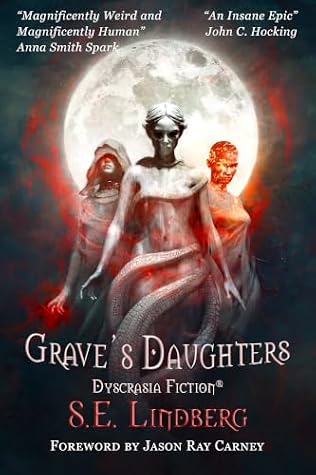
Giveaway ends October 01, 2026.
See the giveaway details at Goodreads.
How does a necromancer care for three risen daughters?
"To raise one family, you will sacrifice another,” Doktor Grave once espoused. Now, striving to be a father instead of a servant to gods, his teachings backfire.
As his golem-body dissolves into the land itself, a nurse with fading sight must finish his work—guiding monstrous daughters, stolen souls, and forbidden rituals toward a future that may demand more blood than anyone intended. Grave’s Daughters is a dark fantasy of legacy, devotion, and the terrible cost of love.
Thanks for the support, friends and fans! As the Grave's Daughters launch contunes,
Moretti's Ristorante and Pizzeria (Aug 2026); David C Smith, Greg Mele, John O'Neill and Joe Bonadonna received signed books and T-shirts fo their support over the years.


Simulcast on Black Gate: Dark Muse News: Reviewing SOIL by James D. Mills

SOIL by James
D. Mills (Arcanist: Fantasy Publishing, December 2026); cover art by Henrik
Karippen[/caption]
This Dark Muse News post reviews James D. Mills'
soon-to-be-released, stand-alone novel SOIL (coming
to BackerKit October 29, 2026; freely available for digital viewing now on Arcanist Online).
Excerpts are shared to give you a feel for the style. This article also
provides a tour guide for the other books in the Dusk and Dawn
series.
Just this July, we covered James D. Mills' crowdfunding
Backerkit campaign Mordschlag
Sword and Sorcery Magazine. Besides publishing, he writes a fair amount
too. His SOIL is a folk-horror fantasy firmly rooted in the soil, or
spirit, of the British Isles. Sword and Sorcery fans will enjoy the elements of
melee action, direct encounters with strange gods, and exploration of mystic
temples. The world and culture are fleshed out, and super-infused with intense
child-bearing motifs (more on that below). With a cast of 6+
protagonists, the book is a solid, dark-fantasy epic. It is the second
stand-alone entry in the Dusk and Dawn series.
Despite the Shins being desolate and dreary, the culture
within the village is very homey. As I became acquainted with the characters
and the village, I was reminded of family dramas struggling to survive in
pioneer/frontier settings, TV series like Little House on the Prairie or
Bonanza. Being based on British geographies, Larkrise to Candleford is
a more appropriate comparison (at least for the general feeling of the
setting). However, the Shins are plagued with all sorts of dark fantasy
monstrosities and mythic curses. Indeed, in the highland village of the Shins,
every child is born into a family or onto an Old God’s dinner plate. In short,
readers should expect the heartfelt drama of "Larkrise to Candleford"
with ghost hunting, child sacrifices, werewolves, and witch trials.
Heroic Characters
So who inhabits the Shins? Key players, your tour guides,
are listed below. Drama between them and the Old Gods abounds. About a third of
these demonstrate extreme heroism and sacrifice. Beware, and enjoy, Mills'
penchant for switching viewpoints in the first-person across various chapters.
This ambitious tactic/style enables readers to experience the madness while
getting to know the characters intimately.
SOIL
The land itself, the titular soil, almost emerges as a
character. If not independent and sentient, the soil in SOIL is spiritually
infused. Hell, this land has a thumping heart whose pulsing beats call out to
believers (victims?). So if you have organs, you may just be a
character! With the backdrop of a Celtic landscape, the Arthurian legends
of synergistic sovereign-nature landscapes are evoked. Instead of a King and
Land being one, SOIL presents the connection between common folk and their
gods, entangling their lack of fertility with the land's blight. On the
positive side, when properly used in a ritual, earth can be used as a pregnancy
test! The interconnectedness of life, divine pacts, and the physical
manifestations of a spiritual curse are rampant. So if it has a heart, maybe it
is a character.
Child, and Child-bearing, Themes
There is a "child theme" that is pervasive
throughout the novel, often manifesting through characters' infertility,
neglect, predation, and spiritual guardianship. Children in the story seem to
represent both the community’s future and a currency (food?) for the gods. All
the relationships amplify this. Whether it's Snorri Morn's abusive
parenting of his daughter Shelka, or Ithica's balance of her own infertility
with the land's fertility (a plentiful harvest), or the Old God (Gørde), the
Draugr youths haunting the landscape, or Baptiste Fournier's obsession with
raising Armelia... the whole setting is brewing with issues of legacy and
parenthood.
What-to-Expect Excerpts
Gory Murders to be Solved
[male character] lay splayed out in the hay in a pool of his own blood, mounted by a pile of his own innards. His clear umber eyes stared at the ceiling. Though gutted, the rest of [him] was unharmed, save for two weeping punctures upon his neck.
Ghost Children
There was also the troubling matter of the Draugr. Baptiste had chased them off over the last several nights. The spirits haunting the troupe were not the lost warriors and elder kings of ancient epics but the spirits of children, who bore the same mark as Ithica and Shelka Morn. Unobtrusive in their dreadful appearances, Baptiste thought they meant to provide warning. For what, Baptiste could only guess. Was such a warning a threat, or an act of solidarity? The spirits walked only behind or beside the troupe. Clearly, they were not bound to the limits of physicality, and if they chose to, could block their path or cause harm to the mortals in his care...
“Be you so enthralled by my impotence!” he howled at the indifferent Draugr. “Must you mock me so?”
Wordlessly, the ethereal children raised their arms, pointing down the slope, towards the approaching interlopers. Confused and grieved, Baptiste knew not if the Draugr offered a warning or a threat....
Child-Eating, Chthonic Monstrosities
The boy was gone in a heartbeat. The Old God’s terrible, ghostly jaw unhinged and swallowed him whole. It seemed more like walking through a doorway than slipping down the God’s gullet. Snapping shut his jaws, the earth trembled with anticipation for what was to come, and the walls shuddered, as if lungs deep in the blackest depths of the Old God’s cave breathed life after eons comatose...
The Old God sighed relief, his eldritch bipedal body quivering—which I shall never look upon willingly—displacing, then morphing into his preferred form; that of a glorious stag with jagged, gilded antlers. For all things, he looked like a stag, lush tawny fur with a belly the color of eggshells, save for his eyes, which were a man’s. Whether the Old God wore those eyes in his terrible, true form, I’ll never know.
Then the Old God bleated like a goat in heat, his knobby cervine legs tremulous as if in the midst of climax. Bowing his head, he gingerly pierced the earth with the sharp point of his longest antler and spun round to draw a circle, before scribbling yet more incomprehensible characters in the soil.
Mythic Melee
Hromgir and his kinsmen rose like revenants beneath the high noon. Teeth bared in a silent snarl, Hromgir lunged at the soldier and drove his dirk through both linen coif and warm flesh into the base of the wretch’s skull.
Seven others bounded past him, sliding dirks and game knives into throats and groins. Arvid coiled his bulging, tattooed arms round a man’s neck.
Hromgir’s prey slumped before him, dead even before the stream of steaming blood spouting from his neck spattered the snow. Hromgir drew the soldier’s broadsword, tossed the body aside, and charged barefoot over the hardpacked snow toward the Wystran scouts.
And More Melee!
Hromgir dashed to the side, his axe hovering overhead. Ramr snarled and lunged. Hromgir caught the blade on his shield, swung with his axe. Ramr withdrew his blade, parrying. Hromgir shifted his grip, capturing the chieftain’s blade under the beard of his axe.
Ramr roared, kicked Hromgir’s shield. Stumbling back a step, Hromgir’s eyes went wide as the beastly man pressed forward with a furious onslaught of savage swipes and cleaving cuts. Steel drummed on basswood, rang against iron. Hromgir retreated with every strike, hunched behind his shield. Fervent and monstrous, Ramr’s tongue sloughed from between his grinning teeth, and he threw back his arm for a high, killing cut...
Hromgir swung wildly at Ramr, who had recovered his sword, carving alternating sweeping arcs with every step. Ramr reeled, parrying and evading most, but also bearing the pain of a few glancing cuts. The chieftain strafed wide, sword held high. ... Ramr slung a brutal overhead slash, then pulled back, dropping the blade low, and thrust towards Hromgir’s belly...
Hromgir tackled the monstrous man, driving him viciously into the mud. They rolled and struggled, grasping and groping. Mounting his injured foe, Hromgir pinned the chieftain’s sword arm to the ground. Ramr pawed with his off-hand, searching for the dagger at his belt. Hromgir roared and smashed his forehead into Ramr’s nose.
Ramr cackled as blood sprayed, giggling as Hromgir beat him senseless, bloodying his fists against the chieftain’s jaw and cheeks and eyes. Ramr’s hands fell limp at his side, twitching with every blow — but his laughter never ceased. Hromgir struck him again. Once, twice, thrice, then he drew his dirk and drove it into the man’s throat with practiced precision.

Tour Guide to the Dusk and Dawn Milieu
All entries are stand-alone tales. Read them in any order!
Story Chronology
James D. Mills is a writer, editor, and a wanderer.
He writes Dark Fantasy and Sword & Sorcery. His main goal is to be awarded
"Best Dad Ever" for 18 consecutive years by the people who matter
most. After that, he wants to topple that record indefinitely. He is best
known for his role as Editor-in-Chief of The Arcanist: Fantasy
Publishing. His Sword & Sorcery has been featured by Michael A.
Stackpole’s Chain Story 2 Project. He is author of the Dark Fantasy
novels, ASHEN
RIDER and SOIL,
which are freely available on Arcanist
Online.
S.E. Lindberg is a Managing Editor
at Blackgate.com, regularly reviewing books, interviewing authors
on ‘Beauty & Art in Weird-Fantasy Fiction’, and running Dark Muse News. He
has taken lead roles organizing the Gen Con Writers’ Symposium (2021-2023) and
the Goodreads Sword & Sorcery Group; he even interned for Tales from the
Magician’s Skull magazine and is an Assistant Editor for Battleborn magazine.
As for crafting stories, he has contributed eight entries across Perseid
Press’s Heroes in Hell and Heroika series,
and has an entry in Weirdbook Annual #3: Zombies. He independently
publishes novels under the banner Dyscrasia Fiction®; short stories of these
have appeared in Whetstone and Swords & Sorcery online
magazine, Rogues In the House Podcast’s A Book of Blades (Vol. I
and Vol. II), DMR’s Terra Incognita, Tales From
the Magician’s Skull, Savage Realms Magazine, and Michael
Stackpole’s S&S Chain Story 2 Project.
Lord Direk struggles to contain the shadow cursing his body when the meddling of unknown entities brings him into contact with the suspicious Doktor Grave. Their shared fascination with the jewels of Tarru-syn may offer Direk deliverance—or be his damnation. Can these strangers from different worlds dare to rely on each other long enough to defeat their common enemy? Will alchemy and will-power be enough to save them from being devoured by the treasures they seek?
Direk, Lord of Vengeance, and Doktor Grave, Physician of Dyscrasia, Face a . . . New? Old? Foe . . . Together!

"...fighting a shadow-swirled dragon-demon that jumps through dimensions in search of gemstones from the shattered crown of Tarru-Syn, and which Grave immediately labels Tarrusynasaurus Rex, is crazy fun enough, but having its shadow react differently to both Direk’s inner makeup and Grave’s own Golem blood and having it all work out in such a way that the resolution of the issue makes perfect sense is quite the fucking achievement. And I’m a bit dense at times, so you know something’s spelled out well enough that even I can get it…...Waltz I’ve waxed on about already, but I believe his dark, violent yarn involving Direk shines all the brighter (darker?) when set against a more patient, calculated protagonist. Doktor Grave fits that role perfectly, injecting a bit of wry humor even, and complementing Direk’s mad whirlwind of hate with some tempered science and cerebral work. Before also jumping in with a giant, anime blade of his own. We can’t have an all-thinky sword & sorcery protagonist, after all.Devourer of Crowns is a surprising collaboration from two authors that know their niche inside and out and play to each other’s strengths. Equal parts dark, action-packed, weird, and exciting, it sets up a daring premise right from the start and doesn’t stumble once on its way to fulfilling its grand finale. Furthermore, it leaves growth room for both characters – whether together or apart, that remains to be seen.
Jason M. Waltz's Substack has these too.
Michael Stackpole's Chain Story post for "Devourer of Crowns"
“Devourer of Crowns” can be read stand-alone, but the
experience will be richer if you check out the Direk and Grave’s preceding
tales (also Chain Stories):
Get all three PDFs in a Triple Pack!
Jason
M. Waltz is a writer, editor, publisher and podcaster who has twice
won Valusian Awards from the Robert E. Howard Foundation. His work has appeared
in Savage Realms Monthly, Swords & Sorceries: Tales of Heroic Fantasy,
Crimson Quill Quarterly, Swords and Sorcery Magazine, and Battleborn Magazine.
He hosts an author-interview videocast at 24 in 42, writes on the Substack Word
Dancing with The Rogue, and offers writers the opportunity to receive the
second best response possible to a story submission via Whet Work by Waltz.
S.E.
Lindberg is a Managing Editor at Black Gate. He has taken lead roles
organizing the Gen Con Writers' Symposium (chairing it in 2023) and has
had assistant editor roles with Tales from the Magician’s Skull and
Battleborn magazines. He has contributed eight entries across Perseid Press’
Heroes in Hell and Heroika series, and publishes short stories and novels under
the banner Dyscrasia Fiction®.
Cover art: Original concept art by Matt
Hilton
Simulcast on Black Gate :

Issue and cover artists: 1 Keith Parkinson (2000), 4 Charles Keegan (2002), 10 Denis Rodier (2007), 12 Bruce Pennington (2008), 15 Donato Giancola (2011)
Learn the lore and allure of Black Gate!
Building on our June 2026 coverage of The
Legend of Top-Shelf Books Open Mic, the near-mythical, yet true, confluence
of many Black Gate contributors and authors, this Dark Muse News
post corners Chief Editor John O'Neill to detail the history of the magazine.
It's over 25 years old!
I learned about Black Gate magazine in 2010 at
the World Fantasy Convention, when Howard Andrew Jones espoused about it on a
panel. I immediately ordered Issue #15, and then the print run ended! Eh gad. I
was late for the party again! (Context in The
Legend of Top-Shelf Books post).
What I adore about Black Gate is its community
of contributors and readers. It attracts people ("Blackgaters") who
love fantasy literature and helping others enjoy it. If you are like me, you
did not join back in 2000, and the magazine, in all its forms, deserves some
explanation.
A condensed history of Black Gate magazine.
Learn the secrets of the grimoire that you are reading
now.
Become part of the lore. Record your Black Gate
memories in the comments!

John O'Neill in
Ottawa in 2022
Thanks for answering our questions, John. Why the name
“Black Gate”?
I love this question, because it delves right into the
nitty-gritty of BG’s history.
Black Gate came out of the dot.com boom of the
mid-nineties. I’d invested in a company called Cyberus – a play on Cerberus,
the 3-headed dog that guarded the gate to the underworld – that grew to become
the largest ISP in Ottawa, Canada. During the heady days of the 90s, we dreamed
of leveraging that success into other ventures, like an online gaming company.
My friend Wayne MacLaurin, CEO of Cyberus, registered blackgate.com as a
possible subsidiary of Cyberus, keeping that underworld motif alive.
Fast-forward a few years, and I’m researching prospective
names for my new fantasy magazine. Every URL I came up with had been nabbed by
that point. But I was surprised that one of my favorites was held by none other
than Wayne MacLaurin. With one quick email, Wayne and I partnered to launch
blackgate.com. Once we had the name, the magazine’s identity came together
quickly.
What were your motivations? The initial editorials (BG
#1 and #2) show a passion for keeping the fantasy magazine form alive.
I thought of Black Gate primarily as an online
business in those days. By the late 90s, I’d been deeply involved in a number
of internet startups, and had helped Dell Magazines and others launch the first
websites for Asimov’s SF, Analog, The Magazine of Fantasy & Science
Fiction, and many others. Demand for online content was exploding.
In 1995 I created an online science fiction hub called SF
Site, using Cyberus equipment and expertise. It grew to over a hundred
thousand monthly readers with virtually zero marketing, and we hosted F&SF
and other magazines for decades. Based on that success, I thought there was a
golden opportunity to launch a print magazine with a cutting-edge digital
presence.
In those days, magazines didn’t even sell subscriptions
online. I was convinced we could quickly establish a sizable online presence,
and show the world how to use the internet to rapidly grow a reader base and
launch a digital brand. I didn’t want us to repeat ourselves with another SF
property, so we chose fantasy.
I picked a genre that the market was clearly clamoring for –
adventure fantasy – and leveraged much of the talent we’d already attracted
with SF Site. We launched the website on August 30, 2000, and our first
issue went to press a few weeks later, just in time for the World Fantasy
Convention in October.
Somehow you got a crew of a dozen people to launch the
magazine. How did you enlist them?
That was easy. At that point SF Site had over 30
regular reviewers and staff, and I invited the most talented among that crew to
contribute – including Rich Horton, Victoria Strauss, Don Bassingthwaite, Marc
Goldstein, David Soyka, Charlene L. Brusso, Lisa DuMond, Paul J. McAuley, and
Todd Ruthman.
The big difference, of course, was that SF Site was a
fan site, whereas Black Gate was a professional publication – meaning we
paid for content. It was not a hardship to get most of the team to join.

Black Gate 1 - November 2000, the print magazine
was born, but the first edition is a different size than the rest. I recall you
had a story about that. What was it?
Glad you asked about that. By 1998 I was part of the
Business Operations team for Motorola, in Schaumburg, Illinois, doing software
acquisitions. In one of the great bits of serendipity of my life, the corporate
lawyer I worked with on those deals was a guy named David Kenzer. I worked with
him every day for two years before discovering that he was the same David
Kenzer who owned one of my favorite game companies, Kenzer & Company,
publishers of Knights of the Dinner Table.
When Dave learned I wanted to publish a magazine, he brought
me to Skokie to introduce me to his printer, A to Z Printing. I knew that I
wanted a magazine that had the same sense of fun and adventure as the pulp
magazines I loved, and for that first meeting I brought a copy of Astounding
Science Fiction from the 1930s with me, to show the printer the size and
feel I was aiming for.
We settled on the oversize format we used for the first
issue, partly because it was the same size as the RPG supplements the printer
was used to. But we quickly discovered that a small reduction would allow us to
use smaller paper, at significant savings. Later issues were all published at
the smaller size.

This excerpt from John O'Neill comes from an Aug
2016 post. Watch the award acceptance speech on Youtube
Yesterday, while I was walking through the crowded halls of
Worldcon in the Kansas City Convention Center, I was given an invitation to the
Hugo Losers party, courtesy of the party’s distinguished host, George RR
Martin. I was quite flattered, as Black Gate was not
even up for a Hugo (we declined the
nomination, as we did last year, to make room for another nominee on the
ballot), but didn’t think much more about it.
The Hugo Losers party is the hottest ticket of the
convention, as I soon discovered. George personally hands out the Alfie Awards
to those Hugo losers whom he feels (quite rightly, I think) were unjustly
robbed of an award by slate shenanigans. And this year he spared no expense to
do it in style, renting out the Midland Theater, hiring a band, and plying
hundreds of guests with fabulous food and drink. The Awards themselves are
gorgeous, constructed of vintage hood ornaments, in honor of the design inspiration
for the first Hugo Awards.
George funds and hosts the awards, but the Alfie’s are in
truth a fan award… the winners are determined by the results of the Hugo
voting. But after the first few were awarded, George announced that the Alfie
committee had the right to give out special awards. And as the sole member of
the committee, he’d decided to give a special award this year to recognize one
publication “for integrity” in declining a Hugo nomination two years in a
row. Without further ado, George announced the award was to be given to Black
Gate, and I was called to the stage to accept it.
It was a very real honor for me. In a very real way George
exemplifies all that’s best about fandom — its inclusiveness, its quest to
reward excellence, and especially its talent for building a community. I was
very proud to accept the award on behalf of everyone who’s worked so hard to
make Black Gate a success these last few years.

Black Gate wins World Fantasy Award
Oct. 2016, John O'Neill posted
about winning the award; excerpt below.
Wow.
In 1996, I started SF Site, one of the first
genre websites. It quickly grew to over 150,000 readers per month. By 1998, as
the most innovative and forward-thinking publications in the genre were
creating the first ground-breaking websites, we decided to do something REALLY
forward-thinking: Launch a print magazine.
Black Gate lasted for 15 print issues, until
2011. In November 2008 our Managing Editor, Howard Andrew Jones, said we should
revamp the magazine’s website. I was the voice of reason. “Seriously, who wants
to read more than one article a month, Jones?”
Undaunted, Howard put together a top-notch team of writers,
and committed to putting daily content on the Black Gate blog.
It was his vision, and speaking personally, I still think it’s completely
bonkers.
But thanks to Bill Ward, David Soyka, Scott Oden, James
Enge, EE Knight, Judith Berman, Rich Horton, and especially Ryan Harvey for
getting the site off the ground (I still think it’s a crazy idea).
In 2010, C.S.E. Cooney commented that my articles would be
taken more seriously if the majority of the words were spelled correctly. She
became our first website editor, and she did an extraordinary job. She raised
our standards enormously.
Today Black Gate has 58 regular and
semi-regular bloggers — including many of you in the audience. Our mandate is
to cover the best neglected fantasy, past and present.
We’ve received many honors over the last decade, but nothing
like this. This is the highlight of 20 years of love and celebration of
fantasy, and on behalf of the entire Black Gate community, thank
you from the bottom of my heart.

Howard Andrew Jones championed expanding the Black
Gate website, transforming it into a mega-blog as it complemented the print
issue.
In January 2025, after Howard Andrew Jones lost his life to
brain cancer, John O'Neill remembered
his dear friend; the excerpt below captures Howard's heroism.
Howard has been a huge part of my personal and professional
life since 2002, when I opened a submission to Black Gate magazine
and found a long, rambling, and extremely enthusiastic cover letter from him,
expressing his delight at finding a quality magazine devoted to heroic fantasy.
The letter ended with “I want in, bad,” and was attached to a terrific tale
featuring two adventurers named Dabir and Asim…
In November 2008 Howard told me he wanted to remake our
website, and post new articles every single day, instead of a few times a
month. I told him he was crazy. How in the world could we produce that much
content, especially without a budget?
Undaunted, Howard put together a top-notch team of writers,
and committed to putting daily content on the Black Gate blog. It
was his vision, and he executed it magnificently, with a little help from Bill
Ward, David Soyka, Scott Oden, James Enge, EE Knight, Ryan Harvey, and others.
Eight years later, the website won a World Fantasy Award — an honor that I
still believe should have been presented to Howard.
Thoughts on the last print issue/stopping print?
Ending the print magazine with issue #15 was a hard decision
to make. I loved the magazine, and I deeply loved publishing fiction --
especially finding new writers, like James Enge, Harry Connolly, Iain Rowan,
Aaron Bradford Starr, Michael Livingston, John C. Hocking, Matthew David
Surridge, Sarah Avery, and many others.
Black Gate started as a business, and that meant
keeping costs manageable. But it was always a side hustle, something I did at
night and on weekends while holding down a full time job. As my career
advanced, those jobs became more and more demanding, and it became more and
more clear that Black Gate was unlikely to ever make enough to allow me
to quit the day job.
As Black Gate became more of a hobby, rather than a
potential off-ramp to my business career, that meant I could treat it as one,
and I no longer had to be quite so rigorous controlling costs. I didn’t mind
spending an extra $300 if it meant getting the cover art I wanted. Or $685 to
add an extra 32 pages. Or $2,300 so we could continue to have top quality
interior art. Gradually it became harder and harder to make the compromises
that were keeping us profitable.
By our tenth year in business we were losing over $12,000 an
issue. No one on the staff was paid, including me. At that point the magazine
was a true labor of love, and we were publishing only one issue a year – a huge
annual production, nearly 400 pages of original fiction, art, and reviews, most
of which I paid for out of my own pocket. As long as I was employed, the cost
really wasn’t a burden.
But in 2012 I left my job as CEO of a small software
business in central Illinois, and the senior position I was expecting at
Motorola didn’t materialize, as the company abruptly announced it was being
acquired by Google. The print version of Black Gate was the first
expense that had to go to stabilize our family finances. I found a job just a
few months later, but by that point it was too late to save the magazine.
I sometimes wonder if there was some way we could have saved
the print version by bridging those months with a crowdfunding campaign or
something similar. But the hard truth is that the print version never sold more
than 1,600 copies per issue. Giving it up allowed us to put all our focus on
the online version of Black Gate, which reached vastly more readers.
By 2015 we finally surpassed SF Site, with over a
hundred thousand monthly readers and 1.6 million page views/month, and in 2016
we won a World Fantasy Award. Our readership has gone up and down in the years
since, but our core readership has proven incredibly loyal, sticking with us
through multiple ups and downs as we’ve weathered the storms of industry change
and provider hiccups.
Are PDFs or back issues still available?
We still have a small number of print copies. Some of our
older issues are sold out, but the rest can still be purchased here.
That's not the case with PDFs. A few years ago, when we
transitioned from the legacy Cyberus servers to our new service provider,
Hostgator, we lost the custom download functionality our architect Rose had
built for us. We also lost the original PDF files. We'd love to rebuild it at
Hostgator, but step one is recreating the high-quality PDFs. Most of our
original production files were lost in a hardware failure in 2006, so this is a
more challenging task than we'd like. But we haven't given up, and hope to recreate
the original PDFs in the next year or so.
Can we talk about unearthing your basement? Are Black
Gate relics in there?
[Click the images for Cave-of-Wonder sizes.]
I don't recommend lining your workspace walls with games like this. Believe me -- it's too easy to get distracted.

There's certainly a fair amount of Black Gate
history!
In the late 90s we finished our basement, and I built an
oversize desk as a work space. That humble office was the global headquarters
for Black Gate's vast publishing empire for the next two decades. I
assembled all the magazines there, and handed all the printing, distribution,
and financial details. When 2,000 copies of Black Gate magazine
arrived from the printer and were dumped in our garage, the whole family would
gather in the kitchen to help me stuff them in envelopes by hand.
Bookcase #31 in The
Black Gate Cave of Wonders


When we finished the basement we left it as a single room,
to give the kids a place to run around. Over the years I built 56 bookshelves
lining the walls of the basement, and those gradually filled with computers
games, books, pulps, comics, science fiction magazines, and vintage role
playing games. Howard used to call it the Cave of Wonders, because it sort of
looked like a well-stocked gaming store.

The ladder to the
comic nook in the Cave of Wonders
When we finished the basement the contractor asked what we
wanted to do with our two crawlspaces. On a whim we decided to have them
carpeted, and put in some lighting. Our kids called them 'comic nooks,' because
on rainy days they'd crawl inside to read comics or play board games. Over the
next 25 years they gradually filled floor-to-ceiling with comics and old games.
Mostly I stay out of them now, and they're home to a lot of spiders.
These days the back
half of the Cave of Wonders is filled with metal shelving
About a decade ago I started building shelving units to
house my growing paperback collection. Those fill half of the basement now,
making a lot of twisting corridors. Each shelf holds 35 long boxes, or about
3600 paperbacks or old magazines. It's a great way to store a lot of old paper,
but it does make it tough to find what you're looking for. Especially since the
collection isn't organized nearly as well as it should be.


I've posted a few pics below to give you a sense of what the
Cave looks like today.

Most of the long boxes on the shelves are filled with vintage paperbacks, although a lot also hold old magazines.


I'm not completely sure where all these corridors go.

There are many hundreds of hours of enjoyable cataloging and fondling ahead to get all these paperback bagged and organized.

The shelves are positioned in front of bookcases, which can make it tough to find some of the older games. If you want something specific in the Cave of Wonders, you need a lot of patience. And a map.


For the love of God, stay out of the crawlspace

Any reflections about most-fun/memorable/impressive
submissions or interactions with artists/authors/fans?
When I look back at the last 25 years, they're filled with
countless fond memories. It's true what they say. You forget the tough times,
and remember the good.
I don't want to close out without sharing a few of my
favorite memories. First and foremost, there were the writers. Being an editor
is a thankless task, especially if you can't afford to pay yourself. But what
made it all worthwhile was finding those magical stories in the slush pile. The
tales from an unknown -- or relative unknown -- that dragged you to the edge of
you seat, and got your pulse pounding. Finding and publishing the first tale of
Morlock, by the amazing James Enge. Publishing an early story by Cory Doctorow.
Derek Kunsken's third published story. Discovering Harry Connolly. Publishing
early work by Martha Wells, Judith Berman, Howard Andrew Jones, Richard Parks,
John R. Fultz, Devon Monk, David B. Coe, Constance Cooper, David Wesley Hill, Ellen
Klages, Tina Jens, Peadar Ò Guilin, Iain Rowan, Aaron Bradford Starr, Michael
Livingston, Jonathan L. Howard, Edward Carmien, Matthew David Surridge, David
Evan Harris, Pete Butler, and so many more.
Something I haven't had the chance to talk about much was
the artwork. I was very proud of the fact that we published so much amazing
artwork by some many brilliant artists. Richard Corben, Chris Pepper, Bernie
Mireault, Chuck Lukacs, Charles Keegan, Todd Lockwood, Leif Jones, Jim Pavelec,
Malcolm McClinton, and so many others.
The last thing I want to talk about is how welcoming the
fantasy community was, and is. We received immediate support and incredible
advice from countless corners as we tried to get our humble magazine off the
ground. There was a very fine fantasy magazine that had just gone on hiatus,
and the publisher contacted me -- unsolicited -- and quietly emailed me his
entire subscription database. We had a surprising number of subscriptions
before we even released our first issue. Rich Horton sent me a check for an
8-isusue sub a week after we announced the magazine.
The fantasy community is still centered around conventions,
and they're still the place to be if you want to meet readers, writers, and
artists, and get plugged into what's happening in the field.
There are more fantasy magazines alive today then there were
when we got started in 1999. Most of them are, like Black Gate, very
small, and run by folks with very little experience, but a whole lot of love
for the genre.
It's heartwarming to see that grass-roots drive to create is
still alive in this field. I hope to stay a part of it for a long time.
S.E. Lindberg is a Managing Editor
at Blackgate.com, regularly reviewing books, interviewing authors
on ‘Beauty & Art in Weird-Fantasy Fiction’, and running Dark Muse News. He
has taken lead roles organizing the Gen Con Writers’ Symposium (2021-2023) and
the Goodreads Sword & Sorcery Group; he even interned for Tales from the
Magician’s Skull magazine and is an Assistant Editor for Battleborn magazine.
As for crafting stories, he has contributed eight entries across Perseid
Press’s Heroes in Hell and Heroika series,
and has an entry in Weirdbook Annual #3: Zombies. He independently
publishes novels under the banner Dyscrasia Fiction®; short stories of these
have appeared in Whetstone and Swords & Sorcery online
magazine, Rogues In the House Podcast’s A Book of Blades (Vol. I
and Vol. II), DMR’s Terra Incognita, Tales From
the Magician’s Skull, Savage Realms Magazine, and Michael
Stackpole’s S&S Chain Story 2 Project.

